This template was built with Webflow's free Prospero UI Kit. Learn more



If your child’s neurologist has brought up vagus nerve stimulation, or VNS, you are probably looking at a device you have never seen before. It is a small implant that sends gentle, regular pulses of electricity to a nerve in the neck, and it has been used for epilepsy for decades.
Families usually hear about VNS after medicines have not brought seizures under control. The National Institute of Neurological Disorders and Stroke notes that a third or more of people with epilepsy get little or no relief from medicine. VNS is one of the options built for them.
This guide walks through how the device works, what results can look like for children, how it differs from the ear clips sold online, and what is known so far for children with SCN2A.
The vagus nerve is a long nerve that runs from the brainstem down through the neck to the chest and belly. It carries messages between the brain and many organs.
A VNS device stimulates that nerve on a set schedule. The idea is that steady input through the nerve changes brain activity in ways that make seizures less likely. Exactly how it does that is still being studied, and researchers have several leading explanations.
VNS is not a cure for epilepsy. It is used alongside seizure medicines, not instead of them, and the goal is fewer seizures.
In the US, the implanted VNS system is approved as an add-on treatment to reduce seizures in people 4 years and older with focal seizures (seizures that start in one part of the brain) that medicines have not controlled. The manufacturer’s labeling notes that safety and effectiveness have not been established outside that approved use.
Whether VNS fits your child is a decision to work through with your child’s epilepsy team.
The system has two pieces. A small, battery-powered generator sits under the skin of the upper chest. A thin lead (wire) runs under the skin from the generator to the vagus nerve on the left side of the neck, where small coils wrap around the nerve.
Surgeons use the left side for a reason. The right vagus nerve is more closely tied to the heart’s natural pacemaker, so stimulating it was thought to carry more risk of slowing the heartbeat. Recent research has questioned how large that difference is, and the left side remains the standard choice.
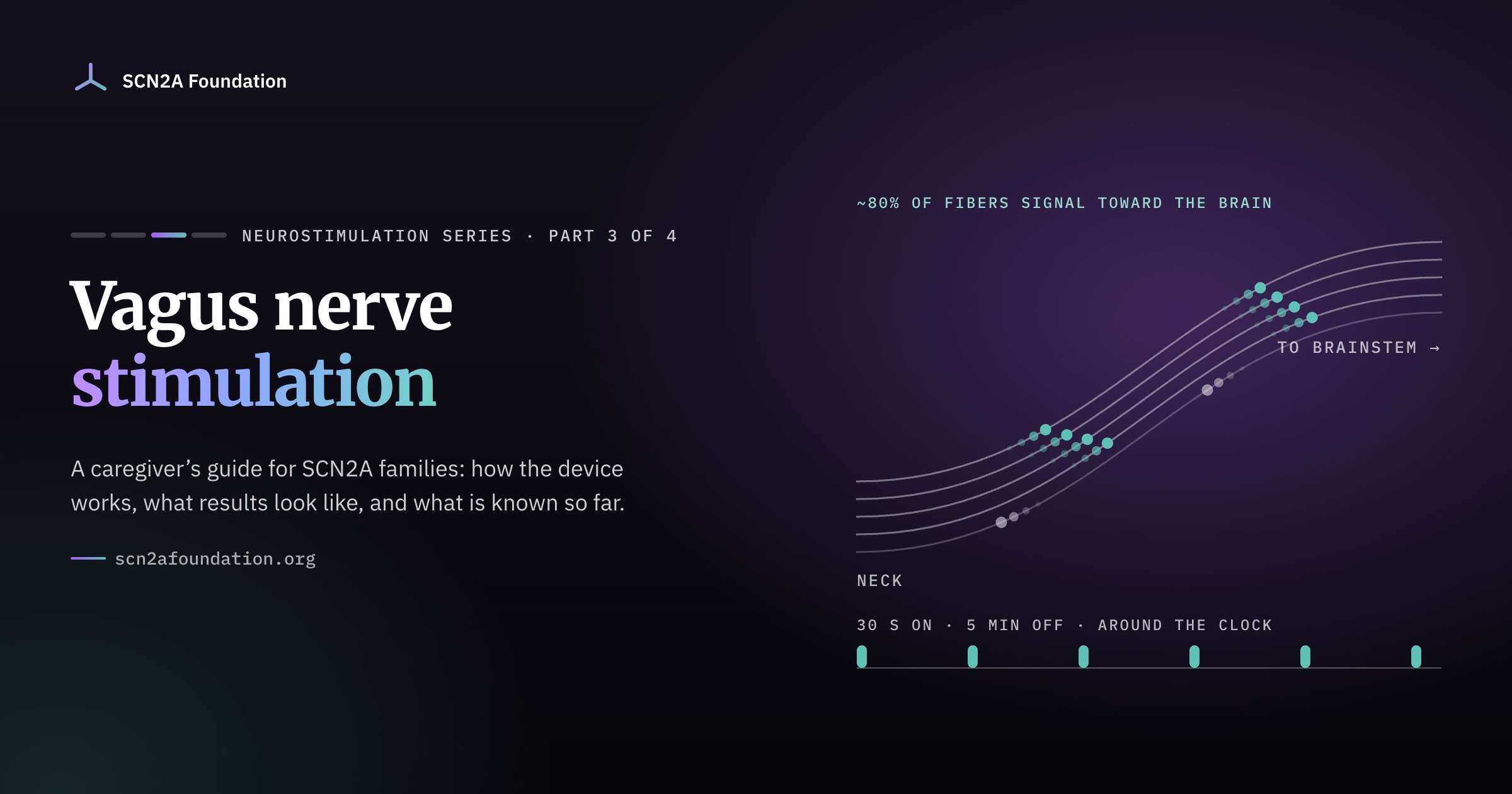
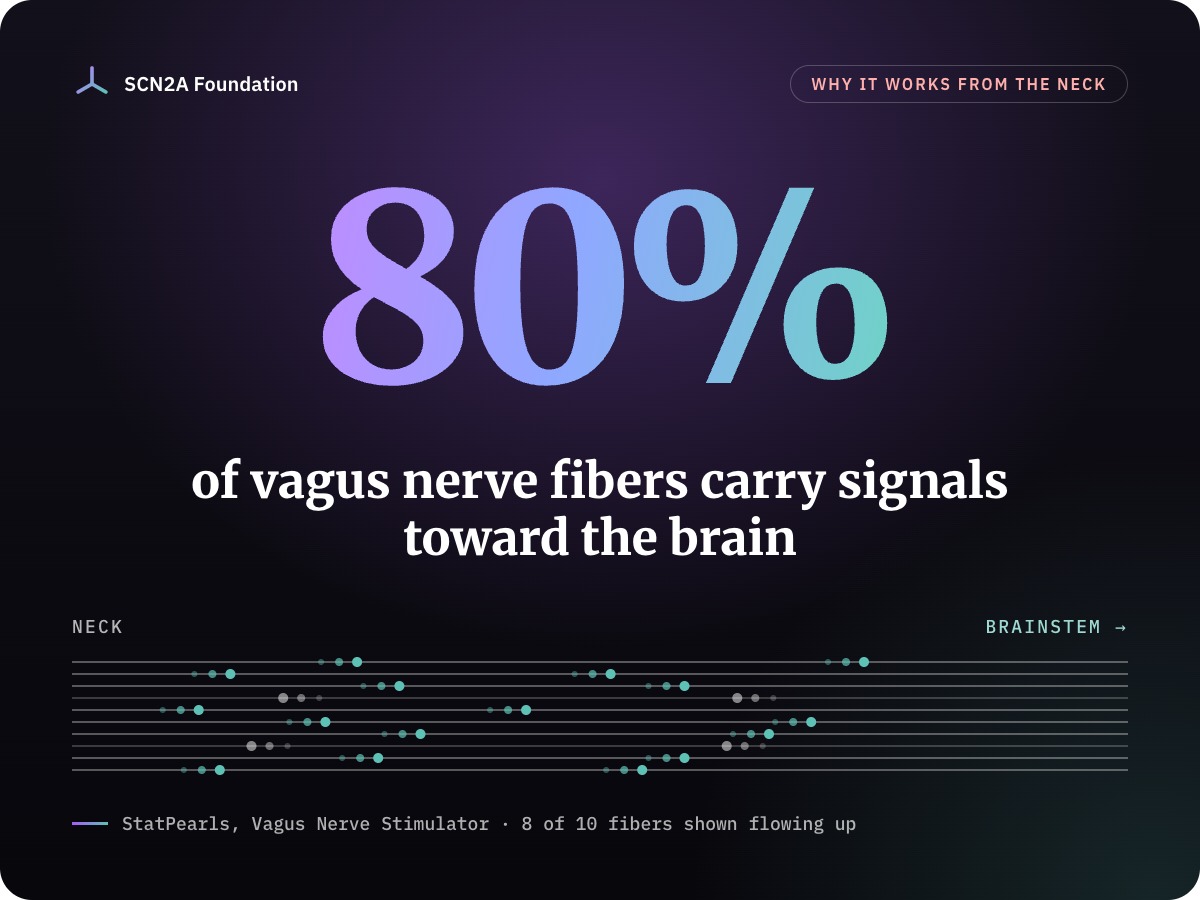
It seems strange that a wire in the neck could affect seizures in the brain. The answer is in how the nerve is built. According to the StatPearls reference on vagus nerve stimulators, about 80 percent of the vagus nerve’s fibers carry signals toward the brain, not away from it.
So pulses delivered in the neck travel up into the brainstem and spread from there. A 2025 review of how VNS works describes it increasing the release of brain chemicals such as norepinephrine and serotonin, which are known to have anti-seizure effects.
Most of the time, the device runs on a repeating cycle. A common setting is 30 seconds of stimulation followed by 5 minutes off, around the clock. In this mode, the device is not watching for seizures. It simply delivers steady input. That is different from a device that responds to brain activity, which senses first and then acts.
Settings are raised gradually. In one pediatric program described below, the device was switched on about two weeks after surgery at a low level, then turned up in small steps every couple of weeks.
Families receive a small magnet. Swiping it over the generator delivers an extra burst of stimulation on demand, such as when a seizure starts. Holding the magnet in place over the generator pauses stimulation. Your child’s care team will explain when to use each.
Some models can also watch heart rate, which makes them a form of closed-loop stimulation. Heart rate often rises around the time of a seizure, and these devices can deliver an extra burst when they detect a sudden jump. Exercise and everyday activity can also raise heart rate, so the care team may adjust how sensitive this feature is or, if needed, turn it off.
The best overall picture for children comes from a 2021 review in Neurology that pooled 101 studies of VNS in children with drug-resistant epilepsy. About 56 percent of children had their seizures cut by half or more at their last follow-up.
Results often take time. In a 2022 study of 20 children with single-gene epilepsies in China, the share of children who responded kept rising through the first year. The authors found results in these genetic epilepsies were similar to results in children with drug-resistant epilepsy overall. That study did not include any children with SCN2A.

Some children did even better. A little more than one in ten children in the 2021 review became seizure-free. In the 2022 study, formal development tests did not change over the first year, but five children who responded reached new milestones or learned new skills as their seizures eased.
Response is hard to predict in advance. The 2022 study included identical twins with the same genetic variant. One twin’s seizures dropped by more than half with VNS, and the other twin’s did not change. The authors concluded that genes alone do not decide how a child responds, which is part of why researchers keep studying who benefits most.
The most common side effects are hoarseness, sore throat, coughing, and shortness of breath. According to the manufacturer’s labeling, these generally happen only while the device is stimulating and usually fade over time. In the 2022 study of children with genetic epilepsies, a few children had hoarseness or a cough at six months, and fewer did by one year.
Because VNS does not stop every seizure, the labeling advises continuing ordinary seizure safety precautions. Families should also tell the care team before any MRI, so the device can be checked and switched off for the scan.
Search for “vagus nerve stimulation device” and you will find ear clips, headphones, and handheld gadgets sold as wellness products. These are not the same as the implanted VNS system used for epilepsy.
The ear devices stimulate the skin of the outer ear, where one small branch of the vagus nerve reaches the surface. That area is also served by several other nerves, so it is hard to know exactly what is being stimulated. A 2021 systematic review in Frontiers in Neuroscience looked at ear stimulation research across many conditions and found that only a small fraction of studies had a low risk of bias.
For epilepsy specifically, there is encouraging research. A 2023 randomized, double-blind trial of 150 people with drug-resistant epilepsy used an ear device called the TVNS-100, made by Xinzhile in Jiangxi, China, and certified by China’s National Institutes for Food and Drug Control. A higher proportion of people receiving active ear stimulation had their seizures cut by more than half, compared with a group receiving low-level control stimulation. The device was used under the trial’s research protocol, and the trial did not study SCN2A. It points to a promising area that researchers are actively exploring.
If you are thinking about an ear device for your child, talk with your child’s neurologist first. These products are not the approved epilepsy treatment described above, and your care team can help you weigh them.
The SCN2A gene gives instructions for a sodium channel called Nav1.2, which helps brain cells send electrical signals. Some variants make the channel more active (gain-of-function). Others make it less active (loss-of-function), and some do a mix of both. You can read more about what an SCN2A variant changes.
VNS is not designed to repair the SCN2A variant. It aims at brain activity, reaching the brain through the nerve.
SCN2A-specific evidence on VNS remains limited, and what exists points in different directions. A 2025 conference abstract described six children with drug-resistant epilepsy that affects development, two of whom had SCN2A. All six had their seizures reduced by more than half after VNS.
A 2022 study of 72 children with SCN2A variants in China reported that no child in the group became seizure-free with VNS. The paper does not say how many children received the device. The two reports measured different things (seizure freedom versus a 50 percent reduction), so both findings can be true at once.
Human evidence has not established gain-of-function or loss-of-function status as a predictor of how a child responds to VNS. Answering that takes more children with SCN2A who have well-described variants and are followed carefully over time.
If VNS comes up, a few questions can help. Ask what kinds of seizures your child has and whether VNS is a good match for them. Ask whether other options, such as surgery, dietary therapy, or deep brain stimulation, have been considered. It also helps to ask how long the team expects before judging whether VNS is working, and how settings will be adjusted along the way. Ask when and how to use the magnet, and who to call if something about the device seems off. If your child has a known SCN2A variant, ask whether it changes the discussion.
Every family navigating an SCN2A diagnosis deserves answers, community, and hope. Add your family to the SCN2A WorldMap. Join our contact registry so we can stay in touch with your family. The work to find answers depends on your support. Please consider making a donation to help fund the research and resources that move us all forward.
This article is for educational purposes only and is not medical advice. It does not recommend any specific treatment. Decisions about epilepsy care, including whether a device like VNS is appropriate, should be made with a qualified neurologist or epilepsy team who knows your child’s full medical history.
Share
If your child’s neurologist has brought up vagus nerve stimulation, or VNS, you are probably looking at a device you have never seen before. It is a small implant that sends gentle, regular pulses of electricity to a nerve in the neck, and it has been used for epilepsy for decades.
Families usually hear about VNS after medicines have not brought seizures under control. The National Institute of Neurological Disorders and Stroke notes that a third or more of people with epilepsy get little or no relief from medicine. VNS is one of the options built for them.
This guide walks through how the device works, what results can look like for children, how it differs from the ear clips sold online, and what is known so far for children with SCN2A.
The vagus nerve is a long nerve that runs from the brainstem down through the neck to the chest and belly. It carries messages between the brain and many organs.
A VNS device stimulates that nerve on a set schedule. The idea is that steady input through the nerve changes brain activity in ways that make seizures less likely. Exactly how it does that is still being studied, and researchers have several leading explanations.
VNS is not a cure for epilepsy. It is used alongside seizure medicines, not instead of them, and the goal is fewer seizures.
In the US, the implanted VNS system is approved as an add-on treatment to reduce seizures in people 4 years and older with focal seizures (seizures that start in one part of the brain) that medicines have not controlled. The manufacturer’s labeling notes that safety and effectiveness have not been established outside that approved use.
Whether VNS fits your child is a decision to work through with your child’s epilepsy team.
The system has two pieces. A small, battery-powered generator sits under the skin of the upper chest. A thin lead (wire) runs under the skin from the generator to the vagus nerve on the left side of the neck, where small coils wrap around the nerve.
Surgeons use the left side for a reason. The right vagus nerve is more closely tied to the heart’s natural pacemaker, so stimulating it was thought to carry more risk of slowing the heartbeat. Recent research has questioned how large that difference is, and the left side remains the standard choice.
It seems strange that a wire in the neck could affect seizures in the brain. The answer is in how the nerve is built. According to the StatPearls reference on vagus nerve stimulators, about 80 percent of the vagus nerve’s fibers carry signals toward the brain, not away from it.
So pulses delivered in the neck travel up into the brainstem and spread from there. A 2025 review of how VNS works describes it increasing the release of brain chemicals such as norepinephrine and serotonin, which are known to have anti-seizure effects.
Most of the time, the device runs on a repeating cycle. A common setting is 30 seconds of stimulation followed by 5 minutes off, around the clock. In this mode, the device is not watching for seizures. It simply delivers steady input. That is different from a device that responds to brain activity, which senses first and then acts.
Settings are raised gradually. In one pediatric program described below, the device was switched on about two weeks after surgery at a low level, then turned up in small steps every couple of weeks.
Families receive a small magnet. Swiping it over the generator delivers an extra burst of stimulation on demand, such as when a seizure starts. Holding the magnet in place over the generator pauses stimulation. Your child’s care team will explain when to use each.
Some models can also watch heart rate, which makes them a form of closed-loop stimulation. Heart rate often rises around the time of a seizure, and these devices can deliver an extra burst when they detect a sudden jump. Exercise and everyday activity can also raise heart rate, so the care team may adjust how sensitive this feature is or, if needed, turn it off.
The best overall picture for children comes from a 2021 review in Neurology that pooled 101 studies of VNS in children with drug-resistant epilepsy. About 56 percent of children had their seizures cut by half or more at their last follow-up.
Results often take time. In a 2022 study of 20 children with single-gene epilepsies in China, the share of children who responded kept rising through the first year. The authors found results in these genetic epilepsies were similar to results in children with drug-resistant epilepsy overall. That study did not include any children with SCN2A.
Some children did even better. A little more than one in ten children in the 2021 review became seizure-free. In the 2022 study, formal development tests did not change over the first year, but five children who responded reached new milestones or learned new skills as their seizures eased.
Response is hard to predict in advance. The 2022 study included identical twins with the same genetic variant. One twin’s seizures dropped by more than half with VNS, and the other twin’s did not change. The authors concluded that genes alone do not decide how a child responds, which is part of why researchers keep studying who benefits most.
The most common side effects are hoarseness, sore throat, coughing, and shortness of breath. According to the manufacturer’s labeling, these generally happen only while the device is stimulating and usually fade over time. In the 2022 study of children with genetic epilepsies, a few children had hoarseness or a cough at six months, and fewer did by one year.
Because VNS does not stop every seizure, the labeling advises continuing ordinary seizure safety precautions. Families should also tell the care team before any MRI, so the device can be checked and switched off for the scan.
Search for “vagus nerve stimulation device” and you will find ear clips, headphones, and handheld gadgets sold as wellness products. These are not the same as the implanted VNS system used for epilepsy.
The ear devices stimulate the skin of the outer ear, where one small branch of the vagus nerve reaches the surface. That area is also served by several other nerves, so it is hard to know exactly what is being stimulated. A 2021 systematic review in Frontiers in Neuroscience looked at ear stimulation research across many conditions and found that only a small fraction of studies had a low risk of bias.
For epilepsy specifically, there is encouraging research. A 2023 randomized, double-blind trial of 150 people with drug-resistant epilepsy used an ear device called the TVNS-100, made by Xinzhile in Jiangxi, China, and certified by China’s National Institutes for Food and Drug Control. A higher proportion of people receiving active ear stimulation had their seizures cut by more than half, compared with a group receiving low-level control stimulation. The device was used under the trial’s research protocol, and the trial did not study SCN2A. It points to a promising area that researchers are actively exploring.
If you are thinking about an ear device for your child, talk with your child’s neurologist first. These products are not the approved epilepsy treatment described above, and your care team can help you weigh them.
The SCN2A gene gives instructions for a sodium channel called Nav1.2, which helps brain cells send electrical signals. Some variants make the channel more active (gain-of-function). Others make it less active (loss-of-function), and some do a mix of both. You can read more about what an SCN2A variant changes.
VNS is not designed to repair the SCN2A variant. It aims at brain activity, reaching the brain through the nerve.
SCN2A-specific evidence on VNS remains limited, and what exists points in different directions. A 2025 conference abstract described six children with drug-resistant epilepsy that affects development, two of whom had SCN2A. All six had their seizures reduced by more than half after VNS.
A 2022 study of 72 children with SCN2A variants in China reported that no child in the group became seizure-free with VNS. The paper does not say how many children received the device. The two reports measured different things (seizure freedom versus a 50 percent reduction), so both findings can be true at once.
Human evidence has not established gain-of-function or loss-of-function status as a predictor of how a child responds to VNS. Answering that takes more children with SCN2A who have well-described variants and are followed carefully over time.
If VNS comes up, a few questions can help. Ask what kinds of seizures your child has and whether VNS is a good match for them. Ask whether other options, such as surgery, dietary therapy, or deep brain stimulation, have been considered. It also helps to ask how long the team expects before judging whether VNS is working, and how settings will be adjusted along the way. Ask when and how to use the magnet, and who to call if something about the device seems off. If your child has a known SCN2A variant, ask whether it changes the discussion.
Every family navigating an SCN2A diagnosis deserves answers, community, and hope. Add your family to the SCN2A WorldMap. Join our contact registry so we can stay in touch with your family. The work to find answers depends on your support. Please consider making a donation to help fund the research and resources that move us all forward.
This article is for educational purposes only and is not medical advice. It does not recommend any specific treatment. Decisions about epilepsy care, including whether a device like VNS is appropriate, should be made with a qualified neurologist or epilepsy team who knows your child’s full medical history.
Vlad Magdalin

Accelerating research and treatment for SCN2A-related disorders.
Get the latest SCN2A research and community news.