This template was built with Webflow's free Prospero UI Kit. Learn more



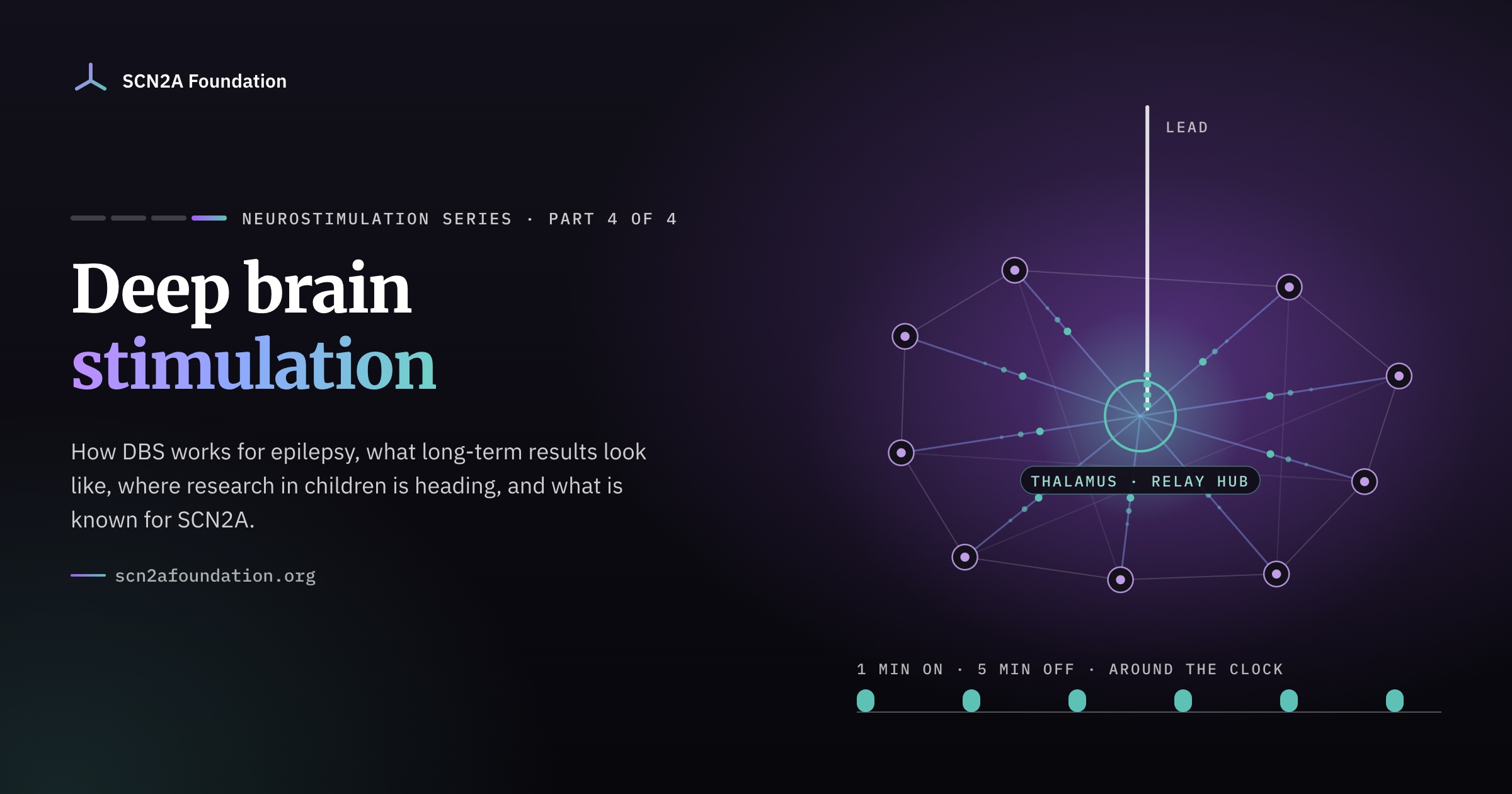
Deep brain stimulation, or DBS, is a treatment for epilepsy that sends gentle electrical pulses to a spot deep in the brain.
Families usually hear about DBS when medicines haven't controlled their child's seizures. This guide covers how DBS works, who it's approved for, what results look like over time, what new research in children shows, and what we know so far for SCN2A.
DBS uses thin wires, called leads, placed deep inside the brain. The leads connect to a small battery-powered device placed under the skin, usually in the chest. The device sends regular, gentle electrical pulses through the leads.
For epilepsy, the leads usually go into the thalamus, a structure near the center of the brain that works like a relay hub, passing signals between many brain regions. Seizures do not stay in one spot. They travel through connected networks, and the thalamus sits along many of those routes.
DBS does not cure epilepsy. It is used alongside seizure medicines, and the goal is fewer seizures.
In 2018, the FDA approved Medtronic's DBS system for epilepsy. It's approved for adults 18 and older whose focal seizures, meaning seizures that start in one part of the brain, haven't been controlled by three or more medicines. DBS is added to those medicines, not used in place of them.
For epilepsy, the approved spot for the leads is a small area of the thalamus called the anterior nucleus, on both sides of the brain.
Children and other target spots in the brain aren't covered by that approval, but both are being actively studied, as you'll see below. Your child's epilepsy team can help you figure out whether DBS is an option for your child.
A seizure doesn't stay in one place. It starts in one spot and can spread through connected parts of the brain, much like traffic moving through a road network. A 2022 review in Brain describes epilepsy this way, as a problem of networks rather than a single spot.
The thalamus is a hub in that network, connected to many brain regions. The anterior nucleus, the part used for epilepsy DBS, sits in a loop of brain regions involved in memory and emotion. By stimulating that hub, DBS aims to make it harder for seizure activity to spread.
DBS for epilepsy runs on a timer. It doesn't wait for a seizure to happen. The standard setting, used in the original trial, is about one minute of stimulation followed by five minutes off, all day and night. Researchers are still testing other settings. In a small 2025 study of 16 people, seizures went down with both the standard setting and a newer one that gives gentle, steady stimulation without breaks.
After surgery, the care team adjusts the settings at follow-up visits. If needed, stimulation can be turned down or switched off. The leads and device stay in place unless a surgeon removes them.
Researchers are also testing a different spot in the thalamus, called the centromedian nucleus. It's being studied for generalized epilepsies, where seizures involve both sides of the brain from the start. Much of the DBS research in children focuses on this spot.
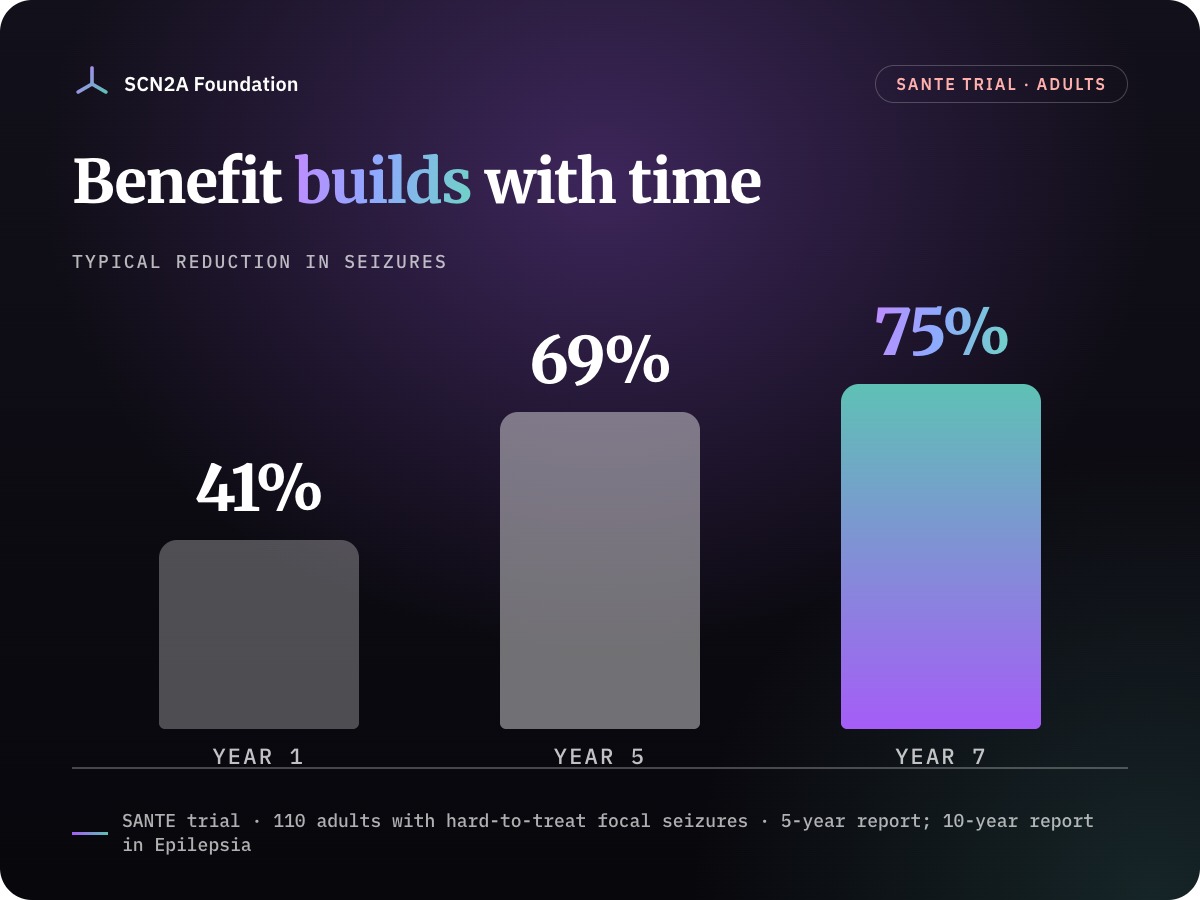
The best long-term data come from the SANTE trial, which led to the US approval. It implanted 110 adults with hard-to-treat focal seizures, and some were followed for 10 years or more. During the first three months, when some participants had stimulation turned on and others did not, the stimulated group saw a larger drop in seizures.
Benefit tended to build with time. In the trial’s five-year report, the typical reduction in seizures was 41 percent at one year and 69 percent at five years. The 10-year report in Epilepsia found it had reached 75 percent by seven years.
Results vary from person to person, and these were adults with focal epilepsy. Still, the long-term pattern is encouraging for anyone weighing a therapy that takes time to show its full effect.
One more finding is worth knowing. In DBS studies, seizures sometimes ease after the surgery but before the device is even switched on. Researchers have offered several possible reasons, including effects of the implantation itself, and how much each contributes has not been established.
As with any brain surgery, placing the leads carries risks such as bleeding and infection. The labeling also asks clinicians to monitor mood and memory after implantation. Your child’s team can walk through what these risks mean for your child specifically.
After surgery, most of the work happens at follow-up visits, where the team adjusts settings and tracks seizures. Because benefit can build over months and years, patience is part of the process.
Two recent trials have tested DBS of the centromedian nucleus in groups that matter to many families reading this.
The ESTEL trial, published in Annals of Neurology in 2022, was the first randomized, double-blind trial of DBS for Lennox-Gastaut syndrome, a severe epilepsy that begins in childhood and involves several seizure types, including tonic seizures. It enrolled 20 young adults in Melbourne, Australia. During the blinded phase, stimulation reduced seizures seen on EEG recordings, though diary-recorded seizures did not show a statistically significant benefit over the control group. By the end of the trial, median seizure counts had fallen by roughly half. The team tracked both EEG and diaries on purpose, because caregiver diaries are not always accurate for counting seizures.
The ADVANCE trial, published in Annals of Neurology in 2024, was the first clinical trial of thalamic DBS in children with drug-resistant epilepsy. It included 18 children, ages 8 to 17, whose seizures had not responded to at least a year of vagus nerve stimulation. Most families chose whether to add DBS or keep adjusting VNS, so families knew which treatment their child received. Children who added DBS, nearly all at the centromedian nucleus, had a 51.9 percent reduction in seizures, compared with 12.3 percent for those who continued VNS alone.
Both trials were small. Together, they show that careful research in children and in severe childhood-onset epilepsies is well underway. A trial of adaptive DBS in children, called CADET, has also been registered.
Research in children has moved carefully for practical reasons too. A clinical review notes that children’s brains and skulls are still growing, which can shift implanted hardware over time. Trials like these are how the field learns to account for that.
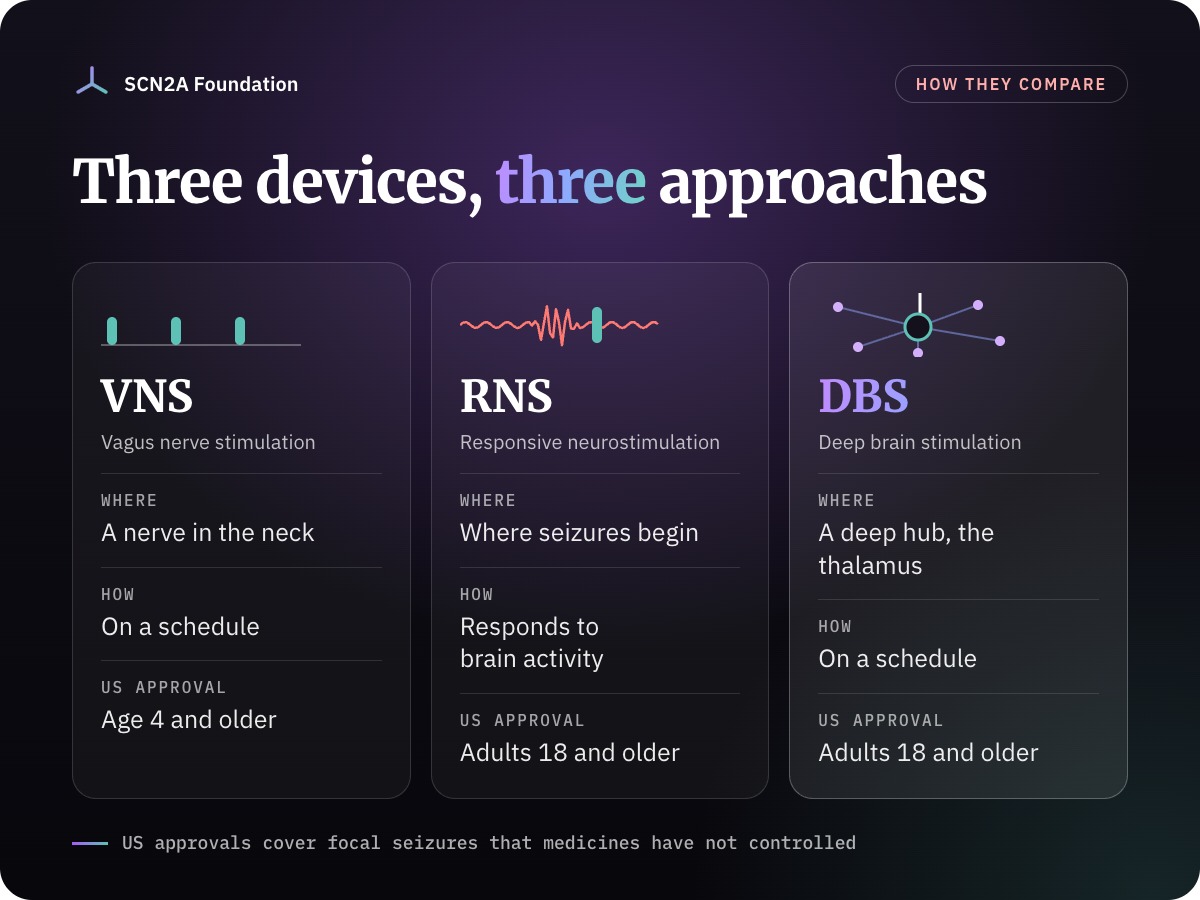
Vagus nerve stimulation stimulates a nerve in the neck rather than the brain itself. It is approved in the US for people 4 and older.
Responsive neurostimulation places leads where seizures begin and responds to brain activity, which makes it a form of closed-loop stimulation.
DBS targets a deep hub in the network and, for epilepsy in the US, stimulates on a schedule.
For families whose child already has VNS, the ADVANCE trial above is especially relevant, since it studied adding DBS after VNS had not been enough.
The SCN2A gene gives instructions for a sodium channel called Nav1.2, which helps brain cells send electrical signals. Some variants make the channel more active (gain-of-function). Others make it less active (loss-of-function), and some do a mix of both. You can read more about what an SCN2A variant changes.
DBS is not designed to repair the SCN2A variant. It works on brain networks, one level above the gene.
The childhood research above is relevant to many SCN2A families. In a 2022 study of 72 children with SCN2A variants in China, most had severe early-onset epilepsies from the broader group known as developmental and epileptic encephalopathies, the same group that includes Lennox-Gastaut syndrome.
SCN2A-specific evidence on DBS itself remains limited. A 2023 report in Child’s Nervous System described DBS used for status dystonicus, a severe and prolonged movement problem, in a toddler with an SCN2A-related disorder. That was a movement-disorder use rather than a seizure treatment, and it shows that DBS has already been used in at least one young child with SCN2A.
There is also animal work. A 2010 study in Epilepsia gave scheduled low-frequency stimulation to a deep brain pathway in six mice with a gain-of-function Scn2a mutation over four days. Seizures fell by 21 percent on average.
Human evidence has not established gain-of-function or loss-of-function status as a predictor of how someone responds to stimulation. Answering that takes children with well-described variants followed carefully over time. You can follow that work through current SCN2A research.
If DBS comes up, a few questions can help. Ask what type of seizures your child has and which part of the brain the team would target. Ask what the surgery and recovery would involve. Ask whether your child would be treated within the approved use or as part of research, and whether any trials might be open to your child. It also helps to ask how long the team expects before judging results, and how settings will be adjusted. Ask how DBS would fit with treatments your child already has, such as VNS. If your child has a known SCN2A variant, ask whether it changes the discussion.
Every family navigating an SCN2A diagnosis deserves answers, community, and hope. Add your family to the SCN2A WorldMap. Join our contact registry so we can stay in touch with your family. The work to find answers depends on your support. Please consider making a donation to help fund the research and resources that move us all forward.
This article is for educational purposes only and is not medical advice. It does not recommend any specific treatment. Decisions about epilepsy care, including whether deep brain stimulation is appropriate, should be made with a qualified neurologist or epilepsy team who knows your child’s full medical history.
Share
Deep brain stimulation, or DBS, is a treatment for epilepsy that sends gentle electrical pulses to a spot deep in the brain.
Families usually hear about DBS when medicines haven't controlled their child's seizures. This guide covers how DBS works, who it's approved for, what results look like over time, what new research in children shows, and what we know so far for SCN2A.
DBS uses thin wires, called leads, placed deep inside the brain. The leads connect to a small battery-powered device placed under the skin, usually in the chest. The device sends regular, gentle electrical pulses through the leads.
For epilepsy, the leads usually go into the thalamus, a structure near the center of the brain that works like a relay hub, passing signals between many brain regions. Seizures do not stay in one spot. They travel through connected networks, and the thalamus sits along many of those routes.
DBS does not cure epilepsy. It is used alongside seizure medicines, and the goal is fewer seizures.
In 2018, the FDA approved Medtronic's DBS system for epilepsy. It's approved for adults 18 and older whose focal seizures, meaning seizures that start in one part of the brain, haven't been controlled by three or more medicines. DBS is added to those medicines, not used in place of them.
For epilepsy, the approved spot for the leads is a small area of the thalamus called the anterior nucleus, on both sides of the brain.
Children and other target spots in the brain aren't covered by that approval, but both are being actively studied, as you'll see below. Your child's epilepsy team can help you figure out whether DBS is an option for your child.
A seizure doesn't stay in one place. It starts in one spot and can spread through connected parts of the brain, much like traffic moving through a road network. A 2022 review in Brain describes epilepsy this way, as a problem of networks rather than a single spot.
The thalamus is a hub in that network, connected to many brain regions. The anterior nucleus, the part used for epilepsy DBS, sits in a loop of brain regions involved in memory and emotion. By stimulating that hub, DBS aims to make it harder for seizure activity to spread.
DBS for epilepsy runs on a timer. It doesn't wait for a seizure to happen. The standard setting, used in the original trial, is about one minute of stimulation followed by five minutes off, all day and night. Researchers are still testing other settings. In a small 2025 study of 16 people, seizures went down with both the standard setting and a newer one that gives gentle, steady stimulation without breaks.
After surgery, the care team adjusts the settings at follow-up visits. If needed, stimulation can be turned down or switched off. The leads and device stay in place unless a surgeon removes them.
Researchers are also testing a different spot in the thalamus, called the centromedian nucleus. It's being studied for generalized epilepsies, where seizures involve both sides of the brain from the start. Much of the DBS research in children focuses on this spot.
The best long-term data come from the SANTE trial, which led to the US approval. It implanted 110 adults with hard-to-treat focal seizures, and some were followed for 10 years or more. During the first three months, when some participants had stimulation turned on and others did not, the stimulated group saw a larger drop in seizures.
Benefit tended to build with time. In the trial’s five-year report, the typical reduction in seizures was 41 percent at one year and 69 percent at five years. The 10-year report in Epilepsia found it had reached 75 percent by seven years.
Results vary from person to person, and these were adults with focal epilepsy. Still, the long-term pattern is encouraging for anyone weighing a therapy that takes time to show its full effect.
One more finding is worth knowing. In DBS studies, seizures sometimes ease after the surgery but before the device is even switched on. Researchers have offered several possible reasons, including effects of the implantation itself, and how much each contributes has not been established.
As with any brain surgery, placing the leads carries risks such as bleeding and infection. The labeling also asks clinicians to monitor mood and memory after implantation. Your child’s team can walk through what these risks mean for your child specifically.
After surgery, most of the work happens at follow-up visits, where the team adjusts settings and tracks seizures. Because benefit can build over months and years, patience is part of the process.
Two recent trials have tested DBS of the centromedian nucleus in groups that matter to many families reading this.
The ESTEL trial, published in Annals of Neurology in 2022, was the first randomized, double-blind trial of DBS for Lennox-Gastaut syndrome, a severe epilepsy that begins in childhood and involves several seizure types, including tonic seizures. It enrolled 20 young adults in Melbourne, Australia. During the blinded phase, stimulation reduced seizures seen on EEG recordings, though diary-recorded seizures did not show a statistically significant benefit over the control group. By the end of the trial, median seizure counts had fallen by roughly half. The team tracked both EEG and diaries on purpose, because caregiver diaries are not always accurate for counting seizures.
The ADVANCE trial, published in Annals of Neurology in 2024, was the first clinical trial of thalamic DBS in children with drug-resistant epilepsy. It included 18 children, ages 8 to 17, whose seizures had not responded to at least a year of vagus nerve stimulation. Most families chose whether to add DBS or keep adjusting VNS, so families knew which treatment their child received. Children who added DBS, nearly all at the centromedian nucleus, had a 51.9 percent reduction in seizures, compared with 12.3 percent for those who continued VNS alone.
Both trials were small. Together, they show that careful research in children and in severe childhood-onset epilepsies is well underway. A trial of adaptive DBS in children, called CADET, has also been registered.
Research in children has moved carefully for practical reasons too. A clinical review notes that children’s brains and skulls are still growing, which can shift implanted hardware over time. Trials like these are how the field learns to account for that.
Vagus nerve stimulation stimulates a nerve in the neck rather than the brain itself. It is approved in the US for people 4 and older.
Responsive neurostimulation places leads where seizures begin and responds to brain activity, which makes it a form of closed-loop stimulation.
DBS targets a deep hub in the network and, for epilepsy in the US, stimulates on a schedule.
For families whose child already has VNS, the ADVANCE trial above is especially relevant, since it studied adding DBS after VNS had not been enough.
The SCN2A gene gives instructions for a sodium channel called Nav1.2, which helps brain cells send electrical signals. Some variants make the channel more active (gain-of-function). Others make it less active (loss-of-function), and some do a mix of both. You can read more about what an SCN2A variant changes.
DBS is not designed to repair the SCN2A variant. It works on brain networks, one level above the gene.
The childhood research above is relevant to many SCN2A families. In a 2022 study of 72 children with SCN2A variants in China, most had severe early-onset epilepsies from the broader group known as developmental and epileptic encephalopathies, the same group that includes Lennox-Gastaut syndrome.
SCN2A-specific evidence on DBS itself remains limited. A 2023 report in Child’s Nervous System described DBS used for status dystonicus, a severe and prolonged movement problem, in a toddler with an SCN2A-related disorder. That was a movement-disorder use rather than a seizure treatment, and it shows that DBS has already been used in at least one young child with SCN2A.
There is also animal work. A 2010 study in Epilepsia gave scheduled low-frequency stimulation to a deep brain pathway in six mice with a gain-of-function Scn2a mutation over four days. Seizures fell by 21 percent on average.
Human evidence has not established gain-of-function or loss-of-function status as a predictor of how someone responds to stimulation. Answering that takes children with well-described variants followed carefully over time. You can follow that work through current SCN2A research.
If DBS comes up, a few questions can help. Ask what type of seizures your child has and which part of the brain the team would target. Ask what the surgery and recovery would involve. Ask whether your child would be treated within the approved use or as part of research, and whether any trials might be open to your child. It also helps to ask how long the team expects before judging results, and how settings will be adjusted. Ask how DBS would fit with treatments your child already has, such as VNS. If your child has a known SCN2A variant, ask whether it changes the discussion.
Every family navigating an SCN2A diagnosis deserves answers, community, and hope. Add your family to the SCN2A WorldMap. Join our contact registry so we can stay in touch with your family. The work to find answers depends on your support. Please consider making a donation to help fund the research and resources that move us all forward.
This article is for educational purposes only and is not medical advice. It does not recommend any specific treatment. Decisions about epilepsy care, including whether deep brain stimulation is appropriate, should be made with a qualified neurologist or epilepsy team who knows your child’s full medical history.
Vlad Magdalin

Accelerating research and treatment for SCN2A-related disorders.
Get the latest SCN2A research and community news.