This template was built with Webflow's free Prospero UI Kit. Learn more



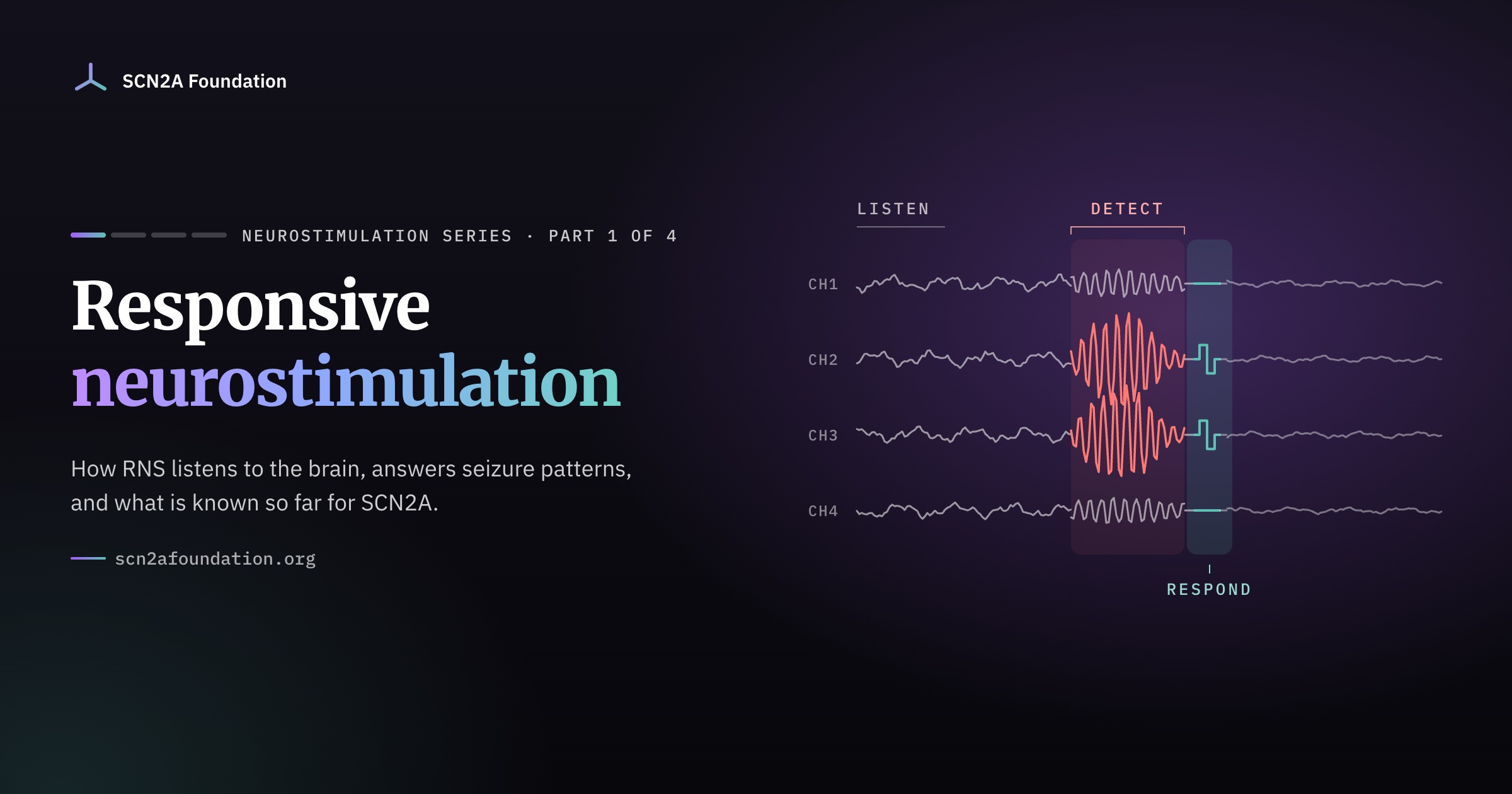
If a neurologist has mentioned “RNS,” they were talking about responsive neurostimulation. It is a seizure treatment that uses a small device placed in the skull. The device watches brain activity around the clock and sends brief pulses of electricity when it sees patterns it has been set up to catch.
Families usually hear about RNS after medicines have not brought seizures under control. That situation is common. Researchers writing in Communications Medicine note that about one in three people with epilepsy keep having seizures even with the many medicines available. RNS is one of the options built for that group.
This guide explains how RNS works in plain language, what long-term results look like, and what is known so far for people with SCN2A-related disorders. If you are reading on behalf of someone with SCN2A, the section near the end is written with you in mind.
RNS is a form of neuromodulation, which means using electrical signals to change how brain cells behave. People sometimes compare it to a heart pacemaker. The difference is that it connects directly to the brain.
It is called a closed-loop system. That means it reacts to what the brain is doing in the moment instead of running on a fixed timer. What the device hears decides when it acts.
RNS does not cure epilepsy. The goal is fewer seizures, and for some people, less severe ones. Its settings can be changed as needs change, and a surgeon can remove it if needed.
In the US, RNS is approved for adults 18 and older with focal seizures, meaning seizures that begin in one area of the brain. Cleveland Clinic describes it as an option when medicines have not worked. It can also be an option when surgery to remove the seizure area isn’t safe, or when an earlier surgery didn’t help enough. The University of Pittsburgh’s program describes candidates as adults whose seizures continued after at least two seizure medicines.
The seizures also need to start in one or two areas that doctors can pinpoint. Finding those areas takes detailed testing by an epilepsy team. Some children’s hospitals, including Nationwide Children’s Hospital, describe using RNS for children after that same careful review.
The system has two main pieces. The neurostimulator is the small device set into the skull. The leads are thin wires that run from the device to the brain areas where seizures begin. At Penn Medicine, the surgery takes about four hours, and most people stay in the hospital one to two days.
Once it is turned on, the device reads the brain’s electrical activity through the leads, day and night. This constant listening is what makes a responsive system possible.
Every person’s seizures look different in their brain signals. So a doctor trained in RNS programs the device to recognize that one person’s patterns. The team teaches it gradually, refining what it watches for over many visits.
When the device spots a pattern it has been set to catch, it sends a short pulse of electricity through the leads. The stimulation is tested in the clinic first to make sure the person tolerates it well.
At follow-up visits, the care team reviews what the device has picked up and fine-tunes the settings. Seizure patterns can change, and the device can change with them.
That record is useful in its own right. Even the longest standard EEGs, which can run for hours or a few days, capture only a small window of time. RNS stores selected stretches of brain activity and event counts over months. Doctors get a much longer view of one person’s brain than a clinic visit can give.
Many descriptions say RNS catches a seizure and shuts it down. That was the original idea behind the design, and research since then has added to it.
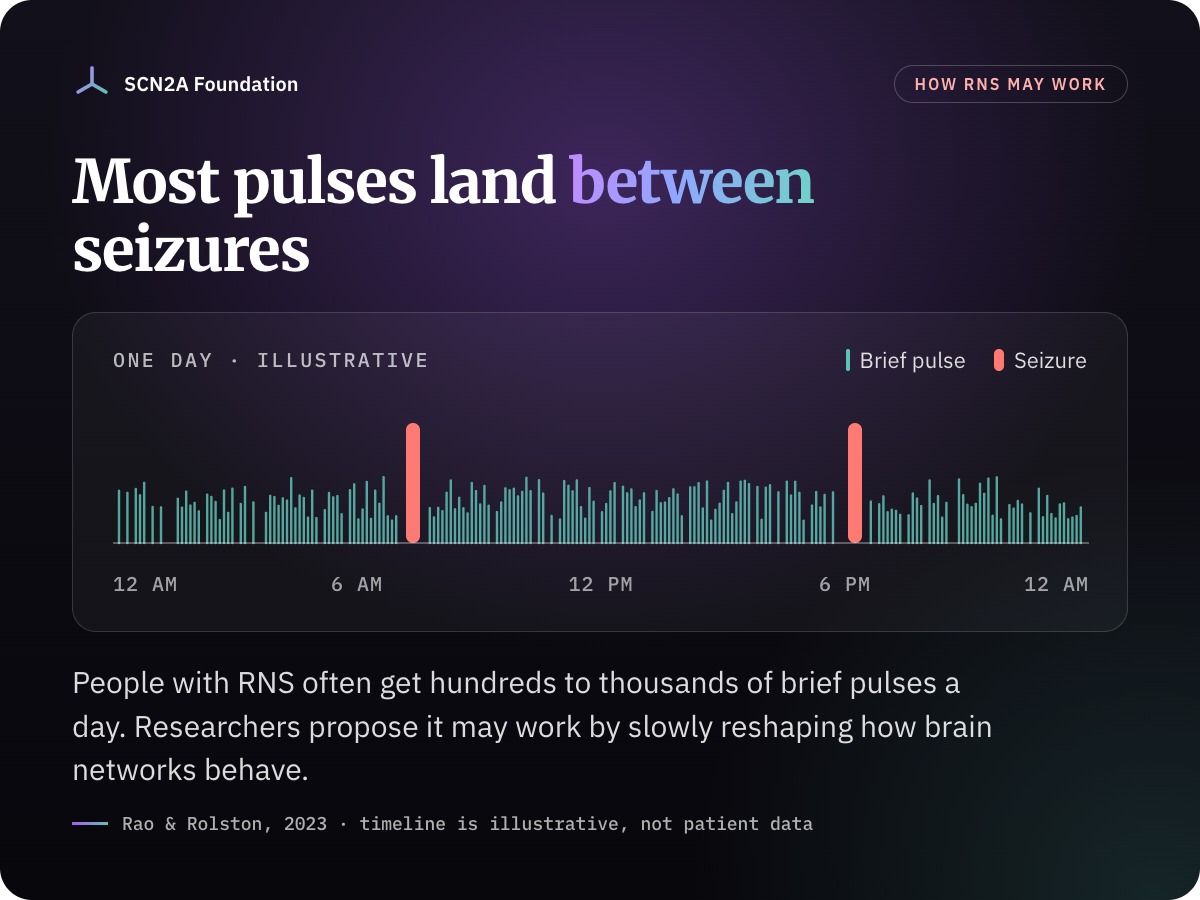
In their 2023 paper, Vikram Rao and John Rolston report that clear examples of stimulation stopping a seizure are uncommon in RNS recordings. Most people with the device receive hundreds to thousands of brief stimulations a day. That is far more than their number of seizures, so most stimulation happens between seizures.
They also point out that pinpointing the exact seizure spot does not by itself guarantee the best result. How that spot connects to the rest of the brain may matter too.
The authors propose that RNS may work by slowly changing how brain networks behave over time. That fits what long-term studies show. Improvement can begin soon after treatment starts, and for many people it keeps building for years.
The authors suggest this model could help explain why results differ between people, and could point the way to making the therapy work better for more of them.
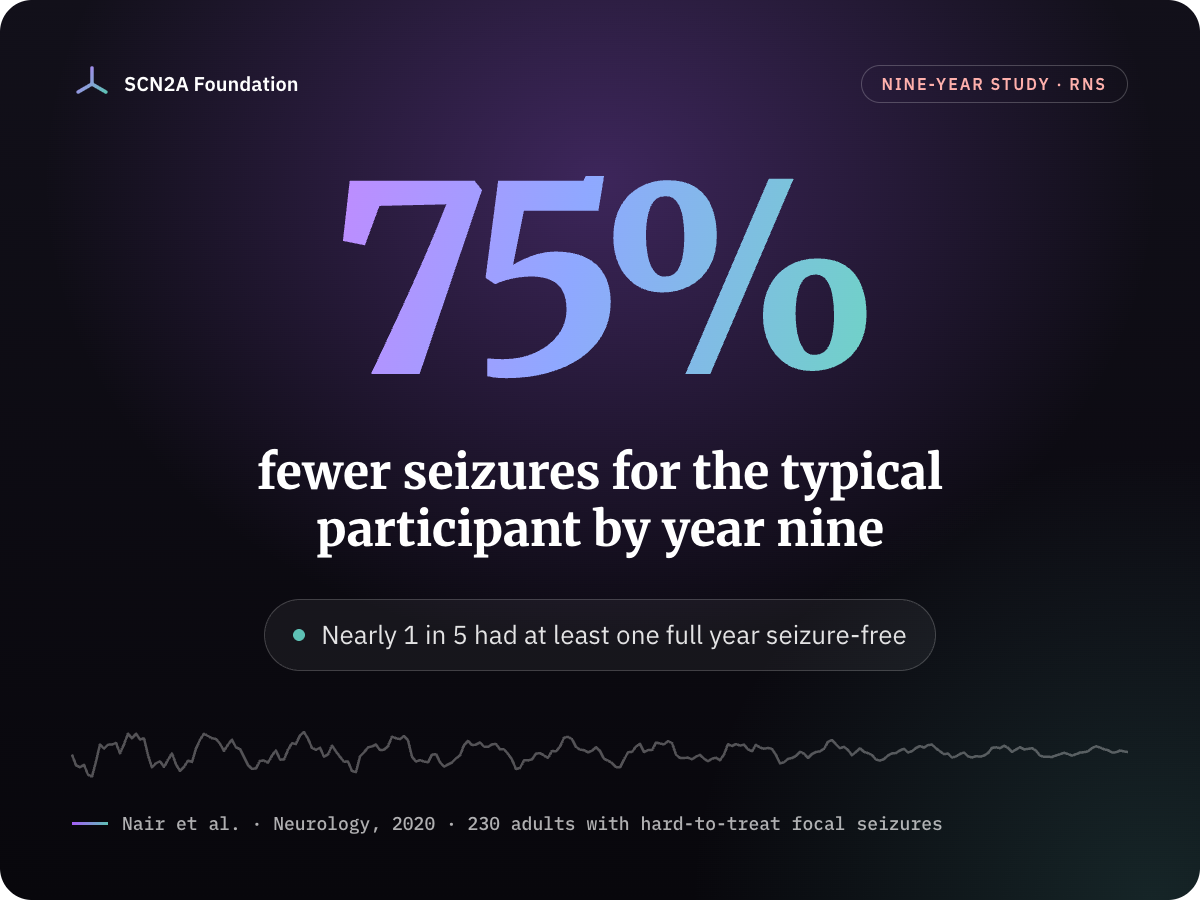
The longest look at RNS comes from a nine-year study published in Neurology in 2020. It followed 230 adults with hard-to-treat focal seizures, many of whom had already tried other surgery or devices.
By the end of year nine, the typical participant had 75 percent fewer seizures than before treatment. That figure had kept climbing from earlier years. The study authors note that, unlike seizure medicines, the response to RNS improved over time.
Some people did especially well. Nearly one in five participants had at least one full year with no seizures at all during the study.
In the later years, everyone received the therapy, so there was no comparison group. And results vary a lot from person to person, with some people seeing little change. Researchers are working to understand why, because the answer could help more people benefit.
RNS is often mentioned alongside two other implanted devices, and the names are easy to mix up.
Deep brain stimulation (DBS) places leads in the thalamus, a relay hub deep in the brain, and stimulates on a regular schedule rather than in response to activity.
Vagus nerve stimulation (VNS) uses a device under the skin of the chest with a wire to the vagus nerve in the neck. According to StatPearls, most of that nerve’s fibers carry signals toward the brain, which is how stimulating it can affect brain activity.
RNS usually sits where seizures begin and responds to what it detects. Researchers have also studied responsive stimulation at deeper targets like the thalamus, though that use falls outside the standard approval.
The SCN2A gene carries instructions for a sodium channel called Nav1.2, which helps brain cells send electrical signals. Some variants make the channel more active (gain-of-function). Others make it less active (loss-of-function), and some do a mix of both. You can read more about what an SCN2A variant changes in the brain.
RNS was designed for focal seizures, so it’s a fair question for many families. In a 2022 study of 72 children with SCN2A variants in China, focal seizures were among the most common seizure types, seen in about 90 percent of the group. The same authors describe a broad range, from mild epilepsy in infancy to severe forms that also affect development. They also note that SCN2A-related epilepsy mostly begins in early childhood. Because the US approval covers adults, families of younger children will want to ask their epilepsy team how that applies. Whether any one person is a candidate depends on where their seizures begin and what testing shows.
RNS and other brain stimulation therapies are not designed to repair the SCN2A variant. They work on brain activity, one level above the gene.
SCN2A-specific evidence on brain stimulation remains limited, and most of it involves other devices. That same 2022 study reports that no child in the group became seizure-free with vagus nerve stimulation, though it does not say how many children received it. A 2025 conference abstract described six children with drug-resistant epilepsy that affects development, two of them with SCN2A, who all had seizures cut by more than half after vagus nerve stimulation. That result is early and uncontrolled, and it is encouraging.
There is also animal work. A 2010 study in Epilepsia gave scheduled low-frequency stimulation, not responsive stimulation, to six mice with a gain-of-function Scn2a mutation over four days. Seizures fell by 21 percent on average.
Human evidence has not established gain-of-function or loss-of-function status as a predictor of how someone responds to stimulation.
These are answerable questions. Answering them takes people with SCN2A variants described consistently and followed over years. You can explore current SCN2A research and connect with families and researchers working on this together.
If RNS comes up, a few questions can make the conversation more useful. Ask where the seizures begin and whether testing can pinpoint those areas. Ask whether surgery to remove a seizure area has been considered, and why RNS might fit better. It also helps to ask what a good result would look like for your family, and how the device would work alongside current medicines. Like any surgery, placing the device carries some risk, so ask the team to walk through what that means for you. You can also ask what the device’s long-term recordings might show your team. If you have a genetic diagnosis, ask whether it changes the discussion.
Every family navigating an SCN2A diagnosis deserves answers, community, and hope. Add your family to the SCN2A WorldMap. Join our contact registry so we can stay in touch with your family. The work to find answers depends on your support. Please consider making a donation to help fund the research and resources that move us all forward.
This article is for educational purposes only and is not medical advice. It does not recommend any specific treatment. Decisions about epilepsy care, including whether a device like RNS is appropriate, should be made with a qualified neurologist or epilepsy team who knows the individual’s full medical history.
Share
If a neurologist has mentioned “RNS,” they were talking about responsive neurostimulation. It is a seizure treatment that uses a small device placed in the skull. The device watches brain activity around the clock and sends brief pulses of electricity when it sees patterns it has been set up to catch.
Families usually hear about RNS after medicines have not brought seizures under control. That situation is common. Researchers writing in Communications Medicine note that about one in three people with epilepsy keep having seizures even with the many medicines available. RNS is one of the options built for that group.
This guide explains how RNS works in plain language, what long-term results look like, and what is known so far for people with SCN2A-related disorders. If you are reading on behalf of someone with SCN2A, the section near the end is written with you in mind.
RNS is a form of neuromodulation, which means using electrical signals to change how brain cells behave. People sometimes compare it to a heart pacemaker. The difference is that it connects directly to the brain.
It is called a closed-loop system. That means it reacts to what the brain is doing in the moment instead of running on a fixed timer. What the device hears decides when it acts.
RNS does not cure epilepsy. The goal is fewer seizures, and for some people, less severe ones. Its settings can be changed as needs change, and a surgeon can remove it if needed.
In the US, RNS is approved for adults 18 and older with focal seizures, meaning seizures that begin in one area of the brain. Cleveland Clinic describes it as an option when medicines have not worked. It can also be an option when surgery to remove the seizure area isn’t safe, or when an earlier surgery didn’t help enough. The University of Pittsburgh’s program describes candidates as adults whose seizures continued after at least two seizure medicines.
The seizures also need to start in one or two areas that doctors can pinpoint. Finding those areas takes detailed testing by an epilepsy team. Some children’s hospitals, including Nationwide Children’s Hospital, describe using RNS for children after that same careful review.
The system has two main pieces. The neurostimulator is the small device set into the skull. The leads are thin wires that run from the device to the brain areas where seizures begin. At Penn Medicine, the surgery takes about four hours, and most people stay in the hospital one to two days.
Once it is turned on, the device reads the brain’s electrical activity through the leads, day and night. This constant listening is what makes a responsive system possible.
Every person’s seizures look different in their brain signals. So a doctor trained in RNS programs the device to recognize that one person’s patterns. The team teaches it gradually, refining what it watches for over many visits.
When the device spots a pattern it has been set to catch, it sends a short pulse of electricity through the leads. The stimulation is tested in the clinic first to make sure the person tolerates it well.
At follow-up visits, the care team reviews what the device has picked up and fine-tunes the settings. Seizure patterns can change, and the device can change with them.
That record is useful in its own right. Even the longest standard EEGs, which can run for hours or a few days, capture only a small window of time. RNS stores selected stretches of brain activity and event counts over months. Doctors get a much longer view of one person’s brain than a clinic visit can give.
Many descriptions say RNS catches a seizure and shuts it down. That was the original idea behind the design, and research since then has added to it.
In their 2023 paper, Vikram Rao and John Rolston report that clear examples of stimulation stopping a seizure are uncommon in RNS recordings. Most people with the device receive hundreds to thousands of brief stimulations a day. That is far more than their number of seizures, so most stimulation happens between seizures.
They also point out that pinpointing the exact seizure spot does not by itself guarantee the best result. How that spot connects to the rest of the brain may matter too.
The authors propose that RNS may work by slowly changing how brain networks behave over time. That fits what long-term studies show. Improvement can begin soon after treatment starts, and for many people it keeps building for years.
The authors suggest this model could help explain why results differ between people, and could point the way to making the therapy work better for more of them.
The longest look at RNS comes from a nine-year study published in Neurology in 2020. It followed 230 adults with hard-to-treat focal seizures, many of whom had already tried other surgery or devices.
By the end of year nine, the typical participant had 75 percent fewer seizures than before treatment. That figure had kept climbing from earlier years. The study authors note that, unlike seizure medicines, the response to RNS improved over time.
Some people did especially well. Nearly one in five participants had at least one full year with no seizures at all during the study.
In the later years, everyone received the therapy, so there was no comparison group. And results vary a lot from person to person, with some people seeing little change. Researchers are working to understand why, because the answer could help more people benefit.
RNS is often mentioned alongside two other implanted devices, and the names are easy to mix up.
Deep brain stimulation (DBS) places leads in the thalamus, a relay hub deep in the brain, and stimulates on a regular schedule rather than in response to activity.
Vagus nerve stimulation (VNS) uses a device under the skin of the chest with a wire to the vagus nerve in the neck. According to StatPearls, most of that nerve’s fibers carry signals toward the brain, which is how stimulating it can affect brain activity.
RNS usually sits where seizures begin and responds to what it detects. Researchers have also studied responsive stimulation at deeper targets like the thalamus, though that use falls outside the standard approval.
The SCN2A gene carries instructions for a sodium channel called Nav1.2, which helps brain cells send electrical signals. Some variants make the channel more active (gain-of-function). Others make it less active (loss-of-function), and some do a mix of both. You can read more about what an SCN2A variant changes in the brain.
RNS was designed for focal seizures, so it’s a fair question for many families. In a 2022 study of 72 children with SCN2A variants in China, focal seizures were among the most common seizure types, seen in about 90 percent of the group. The same authors describe a broad range, from mild epilepsy in infancy to severe forms that also affect development. They also note that SCN2A-related epilepsy mostly begins in early childhood. Because the US approval covers adults, families of younger children will want to ask their epilepsy team how that applies. Whether any one person is a candidate depends on where their seizures begin and what testing shows.
RNS and other brain stimulation therapies are not designed to repair the SCN2A variant. They work on brain activity, one level above the gene.
SCN2A-specific evidence on brain stimulation remains limited, and most of it involves other devices. That same 2022 study reports that no child in the group became seizure-free with vagus nerve stimulation, though it does not say how many children received it. A 2025 conference abstract described six children with drug-resistant epilepsy that affects development, two of them with SCN2A, who all had seizures cut by more than half after vagus nerve stimulation. That result is early and uncontrolled, and it is encouraging.
There is also animal work. A 2010 study in Epilepsia gave scheduled low-frequency stimulation, not responsive stimulation, to six mice with a gain-of-function Scn2a mutation over four days. Seizures fell by 21 percent on average.
Human evidence has not established gain-of-function or loss-of-function status as a predictor of how someone responds to stimulation.
These are answerable questions. Answering them takes people with SCN2A variants described consistently and followed over years. You can explore current SCN2A research and connect with families and researchers working on this together.
If RNS comes up, a few questions can make the conversation more useful. Ask where the seizures begin and whether testing can pinpoint those areas. Ask whether surgery to remove a seizure area has been considered, and why RNS might fit better. It also helps to ask what a good result would look like for your family, and how the device would work alongside current medicines. Like any surgery, placing the device carries some risk, so ask the team to walk through what that means for you. You can also ask what the device’s long-term recordings might show your team. If you have a genetic diagnosis, ask whether it changes the discussion.
Every family navigating an SCN2A diagnosis deserves answers, community, and hope. Add your family to the SCN2A WorldMap. Join our contact registry so we can stay in touch with your family. The work to find answers depends on your support. Please consider making a donation to help fund the research and resources that move us all forward.
This article is for educational purposes only and is not medical advice. It does not recommend any specific treatment. Decisions about epilepsy care, including whether a device like RNS is appropriate, should be made with a qualified neurologist or epilepsy team who knows the individual’s full medical history.
Vlad Magdalin

Accelerating research and treatment for SCN2A-related disorders.
Get the latest SCN2A research and community news.