This template was built with Webflow's free Prospero UI Kit. Learn more


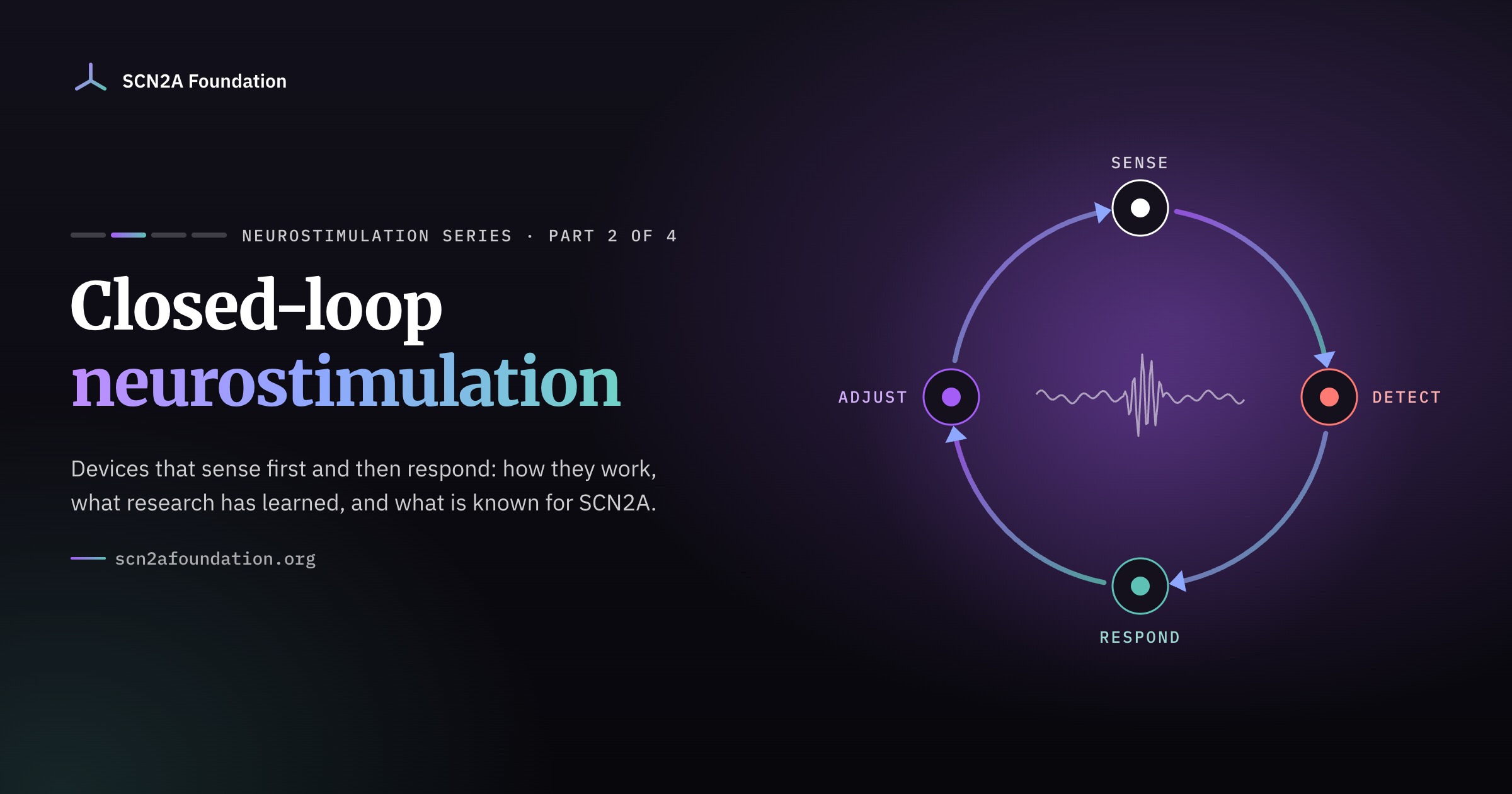
The difference between a timer and a thermostat, a timer turns the heat on at 6 a.m. no matter how warm the house already is, a thermostat checks the temperature first and only acts when it needs to. Brain stimulation for epilepsy works in similar manner and Closed loop neurostimulation is the thermostat version. If your child’s care team has mentioned a device that “listens” or “responds,” this is what they mean.
This guide explains what closed loop means, which devices work this way today, what research has learned about how they help, and what is known so far for children with SCN2A.
Neurostimulation means using small electrical pulses to change how nerve cells behave. Stimulation devices generally fall into two groups.
Open loop devices stimulate on a fixed schedule that a clinician sets. They do not check what the body is doing first.
Closed loop devices measure a signal from the body, such as brain activity or heart rate, and change when or how they stimulate based on what they detect. The “loop” is the path from sensing, to deciding, to acting, and back to sensing again.
Both are used alongside seizure medicines, with the goal of fewer seizures.
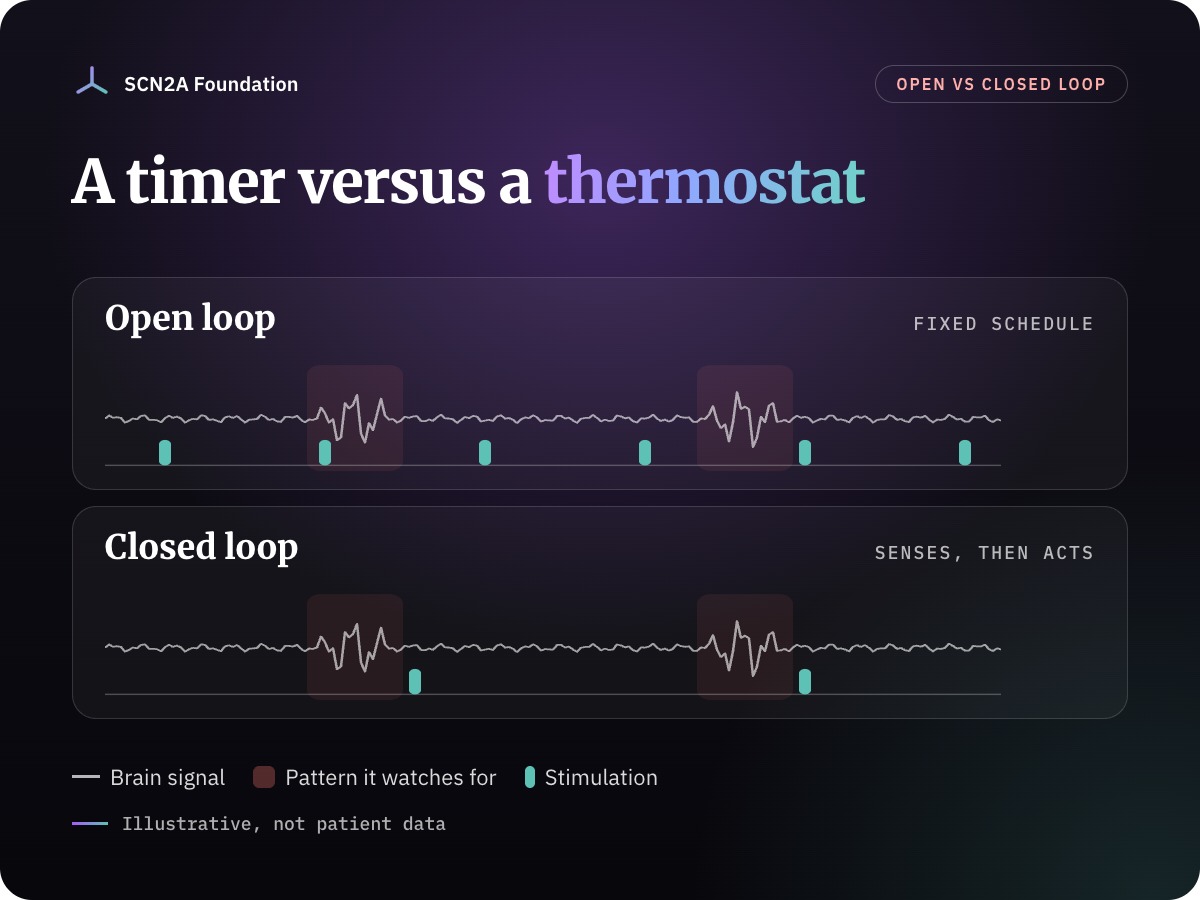
The device collects a signal. Depending on the device, that can be electrical activity recorded directly from the brain or a change in heart rate.
Software inside the device compares that signal against patterns it has been set up to recognize. For a brain-sensing device, a trained doctor programs those patterns for one person’s seizures.
When the device spots a match, it delivers a brief pulse of stimulation. With responsive neurostimulation, for example, the stimulation is tested in the clinic first to make sure the person tolerates it well.
At follow-up visits, the care team reviews what the device recorded and fine-tunes its settings. That human step is part of the loop too. Seizure patterns can change, and the settings can change with them.
Responsive neurostimulation, or RNS, is the best-known closed-loop device for epilepsy. It sits in the skull, listens to brain activity through thin wires, and responds when it detects patterns programmed for that person. In the US it is approved for adults 18 and older with focal seizures that medicines have not controlled.
Vagus nerve stimulation, or VNS, mostly runs on a schedule. Some models add a closed-loop feature that watches heart rate, which often rises around the time of a seizure, and delivers an extra burst when it detects a sudden jump. Because exercise can also raise heart rate, clinicians may adjust how sensitive this feature is or turn it off.
Deep brain stimulation sends pulses to structures deep in the brain. In February 2025, the FDA approved the first adaptive deep brain stimulation system for Parkinson’s disease, which senses brain signals and adjusts stimulation in real time.
The Parkinson’s approval matters for epilepsy families. It shows that sensing and adjusting in real time has moved from the lab into clinical care. A recent review comparing implantable closed-loop systems notes that these adaptive platforms were developed largely for movement disorders, and the review compares them side by side with the systems used for epilepsy.
Devices that listen to the brain also keep a record of what they hear. That gives doctors something they rarely had before.
Even the longest standard EEGs, which can run for hours or a few days, capture only a small window of time. A brain-sensing implant stores selected stretches of brain activity and counts of detected events over months. For a family, that can mean a much fuller picture of how seizure activity rises and falls, and researchers are studying whether it can also show how a person responds to a medicine change.
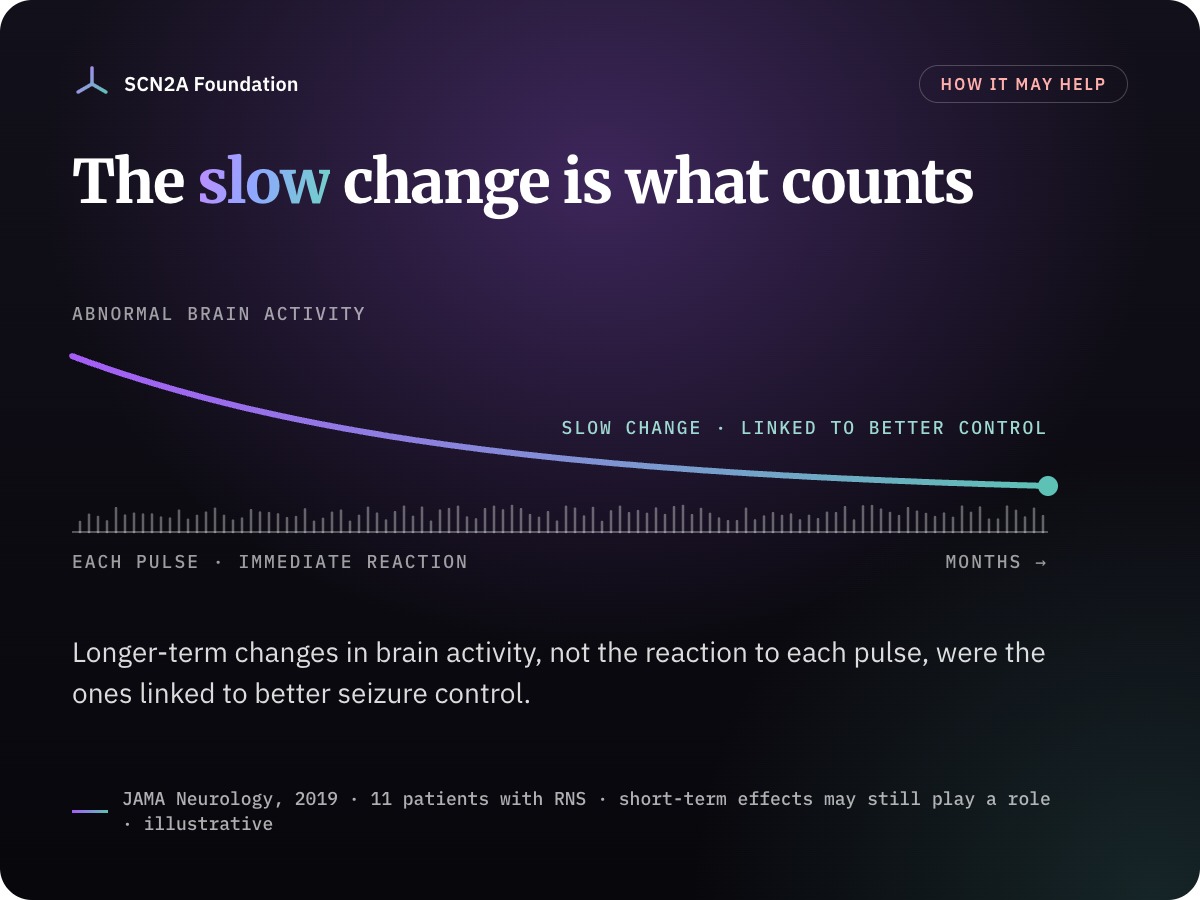
Closed-loop devices were designed to catch a seizure as it starts and stop it. But research on responsive neurostimulation shows that's rarely what happens. A 2023 paper in Communications Medicine found that clear examples of a pulse stopping a seizure are uncommon. Most people with the device get hundreds to thousands of brief pulses a day, far more than their number of seizures. So most of the stimulation happens between seizures, not during them.
That seems to be where the benefit comes from. A 2019 study in JAMA Neurology found that better seizure control was linked to slow, long-term changes in brain activity, not to the effect of any single pulse. A 2024 study in Brain found that people whose devices stimulated more during calm periods, when the brain was quieter, tended to do better.
Vagus nerve stimulation tells a similar story. A 2021 study in Seizure compared people whose devices had the heart-rate feature with people whose devices ran only on a schedule. The closed-loop group improved faster, with a 75 percent typical seizure reduction at about nine months, compared with 50 percent. By two years, both groups had caught up to similar results.
The big takeaway is that these devices seem to work mostly by gradually retraining how brain networks behave. That insight is giving researchers new ideas for making the therapy work better.
If calmer periods matter, one direction is to design devices that deliberately stimulate during those windows, rather than only when something abnormal appears.
Seizures often follow rhythms. In a 2021 study in JAMA Neurology of 222 adults with drug-resistant focal epilepsy, researchers looked for rhythms in seizure timing. Most of those assessed for daily cycles showed them, and many showed longer cycles lasting days or weeks. Researchers hope that knowing these rhythms could one day help devices anticipate higher-risk periods.
Researchers are also testing closed-loop stimulation in new places. A trial funded by the NIH has been studying brain-responsive stimulation of connected thalamic and cortical areas in people 12 and older with Lennox-Gastaut syndrome, a severe epilepsy that begins in childhood. The team published its reasoning and surgical plan in Brain Communications in 2024.
The SCN2A gene gives instructions for a sodium channel called Nav1.2, which helps brain cells send electrical signals. Some variants make the channel more active (gain-of-function). Others make it less active (loss-of-function), and some do a mix of both. You can read more about what an SCN2A variant changes.
Closed-loop stimulation is not designed to repair the SCN2A variant. It works on brain activity, one level above the gene.
Seizure type still matters for any device. In a 2022 study of 72 children with SCN2A variants in China, focal seizures, which start in one part of the brain, were among the most common types, seen in about 90 percent of the group. Whether a particular device fits a particular child depends on where seizures begin and what testing shows.
SCN2A-specific evidence on brain stimulation remains limited. The reports we found involve vagus nerve stimulation and animal work, not brain-sensing devices. A 2025 conference abstract described six children with drug-resistant epilepsy that affects development, two with SCN2A, who all had seizures cut by more than half after vagus nerve stimulation.
A 2010 study in Epilepsia gave scheduled low-frequency stimulation to six mice with a gain-of-function Scn2a mutation over four days. Seizures fell by 21 percent on average.
Human evidence has not established gain-of-function or loss-of-function status as a predictor of how someone responds to stimulation. The research directions above, such as understanding brain rhythms and timing stimulation well, depend on detailed, long-term data from real people.
If a closed-loop device comes up, a few questions can help. Ask what the device would listen for in your child, and whether that fits your child’s seizure types. Ask how the team would judge whether it is working, and how long that usually takes. It also helps to ask what the device’s recordings could show about your child’s seizure patterns over time. You can also ask whether any research studies of these devices might be open to your child.
Every family navigating an SCN2A diagnosis deserves answers, community, and hope. Add your family to the SCN2A WorldMap. Join our contact registry so we can stay in touch with your family. The work to find answers depends on your support. Please consider making a donation to help fund the research and resources that move us all forward.
This article is for educational purposes only and is not medical advice. It does not recommend any specific treatment. Decisions about epilepsy care, including whether a stimulation device is appropriate, should be made with a qualified neurologist or epilepsy team who knows your child’s full medical history.
Share
The difference between a timer and a thermostat, a timer turns the heat on at 6 a.m. no matter how warm the house already is, a thermostat checks the temperature first and only acts when it needs to. Brain stimulation for epilepsy works in similar manner and Closed loop neurostimulation is the thermostat version. If your child’s care team has mentioned a device that “listens” or “responds,” this is what they mean.
This guide explains what closed loop means, which devices work this way today, what research has learned about how they help, and what is known so far for children with SCN2A.
Neurostimulation means using small electrical pulses to change how nerve cells behave. Stimulation devices generally fall into two groups.
Open loop devices stimulate on a fixed schedule that a clinician sets. They do not check what the body is doing first.
Closed loop devices measure a signal from the body, such as brain activity or heart rate, and change when or how they stimulate based on what they detect. The “loop” is the path from sensing, to deciding, to acting, and back to sensing again.
Both are used alongside seizure medicines, with the goal of fewer seizures.
The device collects a signal. Depending on the device, that can be electrical activity recorded directly from the brain or a change in heart rate.
Software inside the device compares that signal against patterns it has been set up to recognize. For a brain-sensing device, a trained doctor programs those patterns for one person’s seizures.
When the device spots a match, it delivers a brief pulse of stimulation. With responsive neurostimulation, for example, the stimulation is tested in the clinic first to make sure the person tolerates it well.
At follow-up visits, the care team reviews what the device recorded and fine-tunes its settings. That human step is part of the loop too. Seizure patterns can change, and the settings can change with them.
Responsive neurostimulation, or RNS, is the best-known closed-loop device for epilepsy. It sits in the skull, listens to brain activity through thin wires, and responds when it detects patterns programmed for that person. In the US it is approved for adults 18 and older with focal seizures that medicines have not controlled.
Vagus nerve stimulation, or VNS, mostly runs on a schedule. Some models add a closed-loop feature that watches heart rate, which often rises around the time of a seizure, and delivers an extra burst when it detects a sudden jump. Because exercise can also raise heart rate, clinicians may adjust how sensitive this feature is or turn it off.
Deep brain stimulation sends pulses to structures deep in the brain. In February 2025, the FDA approved the first adaptive deep brain stimulation system for Parkinson’s disease, which senses brain signals and adjusts stimulation in real time.
The Parkinson’s approval matters for epilepsy families. It shows that sensing and adjusting in real time has moved from the lab into clinical care. A recent review comparing implantable closed-loop systems notes that these adaptive platforms were developed largely for movement disorders, and the review compares them side by side with the systems used for epilepsy.
Devices that listen to the brain also keep a record of what they hear. That gives doctors something they rarely had before.
Even the longest standard EEGs, which can run for hours or a few days, capture only a small window of time. A brain-sensing implant stores selected stretches of brain activity and counts of detected events over months. For a family, that can mean a much fuller picture of how seizure activity rises and falls, and researchers are studying whether it can also show how a person responds to a medicine change.
Closed-loop devices were designed to catch a seizure as it starts and stop it. But research on responsive neurostimulation shows that's rarely what happens. A 2023 paper in Communications Medicine found that clear examples of a pulse stopping a seizure are uncommon. Most people with the device get hundreds to thousands of brief pulses a day, far more than their number of seizures. So most of the stimulation happens between seizures, not during them.
That seems to be where the benefit comes from. A 2019 study in JAMA Neurology found that better seizure control was linked to slow, long-term changes in brain activity, not to the effect of any single pulse. A 2024 study in Brain found that people whose devices stimulated more during calm periods, when the brain was quieter, tended to do better.
Vagus nerve stimulation tells a similar story. A 2021 study in Seizure compared people whose devices had the heart-rate feature with people whose devices ran only on a schedule. The closed-loop group improved faster, with a 75 percent typical seizure reduction at about nine months, compared with 50 percent. By two years, both groups had caught up to similar results.
The big takeaway is that these devices seem to work mostly by gradually retraining how brain networks behave. That insight is giving researchers new ideas for making the therapy work better.
If calmer periods matter, one direction is to design devices that deliberately stimulate during those windows, rather than only when something abnormal appears.
Seizures often follow rhythms. In a 2021 study in JAMA Neurology of 222 adults with drug-resistant focal epilepsy, researchers looked for rhythms in seizure timing. Most of those assessed for daily cycles showed them, and many showed longer cycles lasting days or weeks. Researchers hope that knowing these rhythms could one day help devices anticipate higher-risk periods.
Researchers are also testing closed-loop stimulation in new places. A trial funded by the NIH has been studying brain-responsive stimulation of connected thalamic and cortical areas in people 12 and older with Lennox-Gastaut syndrome, a severe epilepsy that begins in childhood. The team published its reasoning and surgical plan in Brain Communications in 2024.
The SCN2A gene gives instructions for a sodium channel called Nav1.2, which helps brain cells send electrical signals. Some variants make the channel more active (gain-of-function). Others make it less active (loss-of-function), and some do a mix of both. You can read more about what an SCN2A variant changes.
Closed-loop stimulation is not designed to repair the SCN2A variant. It works on brain activity, one level above the gene.
Seizure type still matters for any device. In a 2022 study of 72 children with SCN2A variants in China, focal seizures, which start in one part of the brain, were among the most common types, seen in about 90 percent of the group. Whether a particular device fits a particular child depends on where seizures begin and what testing shows.
SCN2A-specific evidence on brain stimulation remains limited. The reports we found involve vagus nerve stimulation and animal work, not brain-sensing devices. A 2025 conference abstract described six children with drug-resistant epilepsy that affects development, two with SCN2A, who all had seizures cut by more than half after vagus nerve stimulation.
A 2010 study in Epilepsia gave scheduled low-frequency stimulation to six mice with a gain-of-function Scn2a mutation over four days. Seizures fell by 21 percent on average.
Human evidence has not established gain-of-function or loss-of-function status as a predictor of how someone responds to stimulation. The research directions above, such as understanding brain rhythms and timing stimulation well, depend on detailed, long-term data from real people.
If a closed-loop device comes up, a few questions can help. Ask what the device would listen for in your child, and whether that fits your child’s seizure types. Ask how the team would judge whether it is working, and how long that usually takes. It also helps to ask what the device’s recordings could show about your child’s seizure patterns over time. You can also ask whether any research studies of these devices might be open to your child.
Every family navigating an SCN2A diagnosis deserves answers, community, and hope. Add your family to the SCN2A WorldMap. Join our contact registry so we can stay in touch with your family. The work to find answers depends on your support. Please consider making a donation to help fund the research and resources that move us all forward.
This article is for educational purposes only and is not medical advice. It does not recommend any specific treatment. Decisions about epilepsy care, including whether a stimulation device is appropriate, should be made with a qualified neurologist or epilepsy team who knows your child’s full medical history.
Vlad Magdalin
Accelerating research and treatment for SCN2A-related disorders.
Get the latest SCN2A research and community news.