This template was built with Webflow's free Prospero UI Kit. Learn more



Much of the coverage of SCN2A research is about genetic medicine, gene editing, antisense therapies, CRISPR. Most of those approaches remain years away from any child.
A different category of treatment has moved through late-stage trials and is now under FDA review. It is not a gene therapy. It is a small molecule, taken by mouth.
This article explains what small molecules are and which ones are in development for SCN2A-related disorders.
The term sounds like jargon because it is, but the idea is straightforward. The National Center for Advancing Translational Sciences at the NIH puts it simply. "A small molecule drug is a drug that can enter cells easily because it has a low molecular weight."
Most medications you have taken are small molecules. Ibuprofen is one, as are most antiseizure medications in common use. They are manufactured through chemical synthesis, usually swallowed rather than injected, and small enough to slip through cell membranes and reach targets inside cells.
The contrast matters for understanding the SCN2A pipeline.
The FDA notes that most conventional drugs "are chemically synthesized and their structure is known." Most biologics, by contrast, "are complex mixtures that are not easily identified or characterized." Genetic medicines go further still. They act on the gene itself, or on the RNA message the gene produces.
An antisense oligonucleotide, for example, is a short strand of engineered genetic material. It is given by spinal injection, and it changes how much of a protein a cell makes. Gene editing approaches such as base editing go further still, rewriting the DNA itself.
A small molecule does none of that. It leaves the gene alone and works on the protein the gene has already built: here, a channel in the membrane of a brain cell.
That is a limitation and an advantage at once. It will not correct the underlying variant. It also does not require solving the problem of delivering genetic material safely into a child's brain, which is why small molecules are further along. They are also generally swallowed rather than infused or injected into spinal fluid. That makes them far simpler to give, which matters to a family already managing a heavy medical schedule.
The SCN2A gene provides instructions for building part of a sodium channel called NaV1.2. These channels sit in the membranes of brain cells and control the flow of sodium ions, which is how neurons generate and pass along electrical signals. We explain how SCN2A affects the NaV1.2 channel in more depth separately.
When a variant leaves the channel overactive, such as with gain-of-function variants, neurons can fire too readily. When a variant leaves the channel underactive or absent, a loss-of-function variant, signaling is reduced. Mixed function variants do some of both.
That difference runs through everything below. SCN2A does not point to one universal treatment target. The right strategy depends on what a variant does and how that change affects cells and brain networks. For gain-of-function disease, treatment may involve reducing excessive sodium channel activity. For loss-of-function disease, research may instead focus on restoring SCN2A or NaV1.2 activity, or on addressing the downstream consequences of reduced function.
Relutrigine (developed under the code PRAX-562) is the first of those approaches: a medicine built to reduce excessive sodium channel activity. It is the small molecule closest to a regulatory decision for SCN2A-related disorders.
Relutrigine modulates voltage-gated sodium channels and was developed to inhibit the persistent sodium current preferentially. This is the small portion of sodium current that keeps flowing after most of the current has switched off. Excess persistent current can keep neurons closer to the firing threshold and contribute to repeated electrical activity and seizures.
The drug is designed to quiet that abnormal persistent current while leaving more of the larger peak sodium current alone. Ordinary signaling depends on that peak current. This selectivity is what sets relutrigine apart from older sodium channel medicines, which act on both.
Praxis measured that selectivity in a 2022 study published in Epilepsia. In patch-clamp recordings, relutrigine blocked persistent current with roughly 60-fold selectivity over resting block of peak current. Those measurements were made in laboratory cells, so the number describes how the molecule behaves at the channel rather than a clinical result in children. A 2026 review adds that the ratio, while large, is finite, and that some peak-current block is expected at higher exposures. The EMBOLD results below are the clinical test of whether that selectivity translates into fewer seizures.
EMBOLD studied relutrigine in children and young people with early-onset SCN2A-DEE or SCN8A-DEE. For SCN2A, that meant a documented variant with seizure onset in the first three months of life. This is the group the results describe.
Praxis built the trial so that every enrolled child received relutrigine. Participants were randomized one-to-one to either relutrigine for all 16 weeks or relutrigine for 12 weeks with a matching placebo for one four-week period. Families and investigators were blinded to the timing of that placebo window, preserving a blinded comparison. For children with seizures this severe, a design that guarantees each participant active treatment matters, and it still produced placebo-controlled data. The medicine was given by mouth or through a feeding tube.
The trial ran in two cohorts.
Cohort 1 randomized 16 children. Eight received relutrigine throughout; eight had a blinded four-week placebo period. Praxis reported a 46% placebo-adjusted reduction in motor seizures (p=0.0354). One in three participants was reported seizure-free at 16 weeks, and the 2024 presentation noted one child with seizure-free follow-up beyond 200 days.
Cohort 2, the registrational cohort, randomized 53 participants. Fifty-one contributed to the relutrigine analysis and 25 to the placebo-period analysis, with 23 participants in both. Three children left the study before completing it. One family withdrew consent during the placebo period, one child stopped after an adverse event while on relutrigine, and one child passed away during the placebo period. Praxis reported that all serious adverse events were judged unrelated to relutrigine and were consistent with the underlying disease.
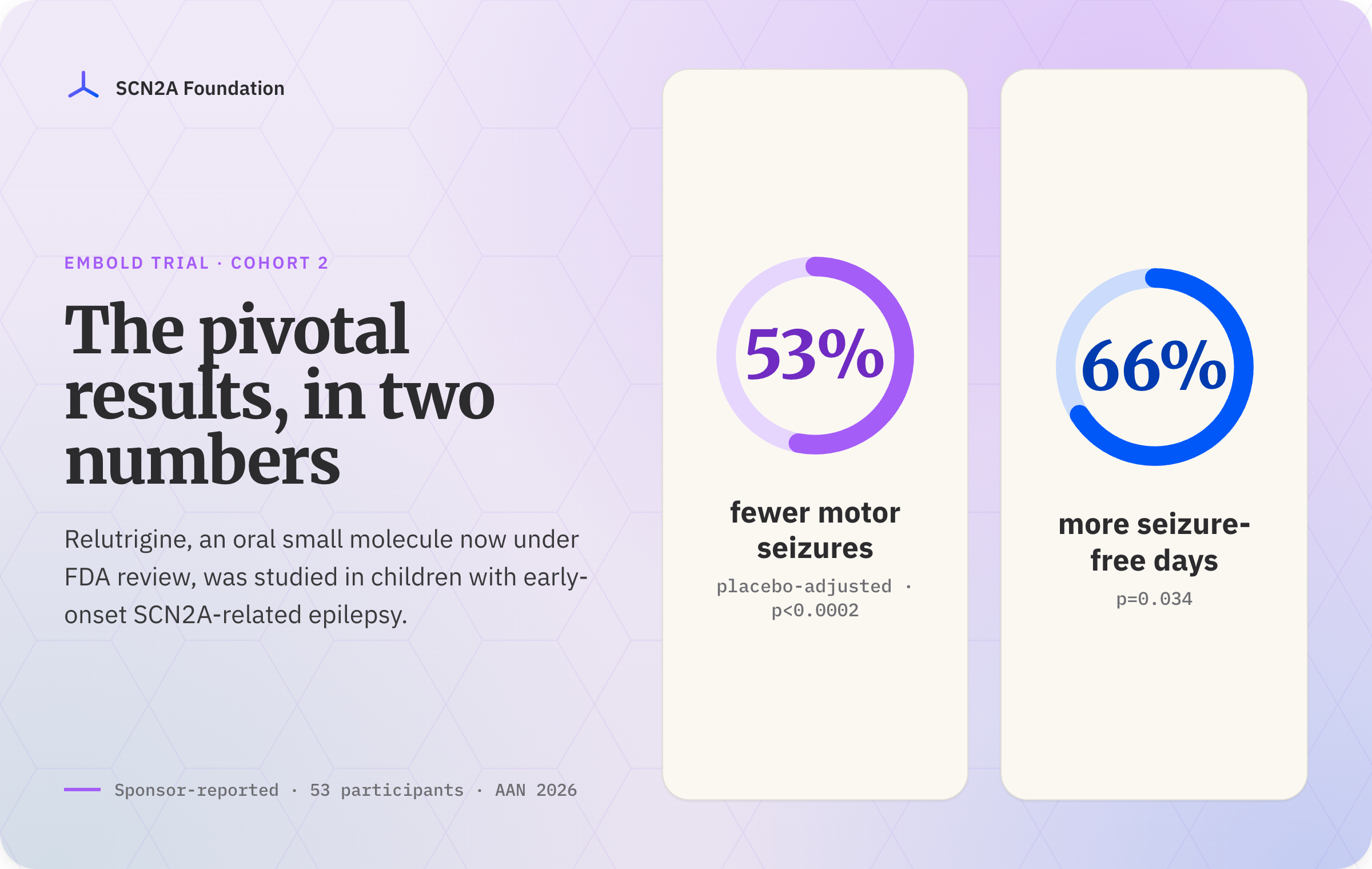
The results in Cohort 2 were stronger than in Cohort 1. Praxis reported a 53% placebo-adjusted reduction in motor seizures over 16 weeks (p<0.0002) and a 66% increase in motor seizure-free days (p=0.034). The signal was clear enough that an independent Data Monitoring Committee recommended stopping enrollment early for efficacy, at 53 of a planned 80 participants. The open-label extension continued, so children in the study kept receiving the drug.
On safety, Praxis reported no drug-related serious adverse events, and side effects were described as mostly mild to moderate. The most common were fever, sleepiness, and upper respiratory infection. Reported per 100 patient-months, fever and sleepiness occurred at similar or lower rates during relutrigine exposure than during placebo (11.74 versus 13.35, and 9.13 versus 13.35). At the same time, upper respiratory infection was higher on drug (9.79 versus 4.45). The placebo windows were short, about four weeks per participant, so these comparisons rest on small numbers. The figures come from Praxis conference presentations; peer-reviewed publication is still to come.
EMBOLD enrolled children with a documented SCN2A variant and seizure onset in the first three months of life, the group most often associated with gain-of-function variants. Children with a functionally characterized loss-of-function variant were not eligible, nor were children whose seizures had previously worsened on a sodium channel blocking medication. This is consistent with the drug's mechanism: it lowers channel activity, which is the goal in gain-of-function disease, not loss-of-function disease. Families with loss-of-function variants can read about the approaches being developed for them further down.
The FDA granted Breakthrough Therapy Designation in July 2025, alongside Orphan Drug and Rare Pediatric Disease designations. Praxis submitted a New Drug Application, and the FDA accepted it with Priority Review on March 30, 2026, with an original decision date of September 27.
In June 2026, Praxis announced that the FDA had extended its review to December 27, 2026. The agency classified additional analyses of existing data as a major amendment, which adds review time. No new clinical studies were requested, and the FDA cited no safety or manufacturing concerns. In August 2026, Praxis confirmed that no advisory committee meeting is planned. If approved, relutrigine would be the first medicine developed specifically for SCN2A-related disorders to reach families.
A larger Phase 3 trial, EMERALD, is studying relutrigine across a broad range of genetically defined developmental and epileptic encephalopathies in participants aged 2 to 65. Results are expected in late 2026.
NBI-355 appears on Neurocrine Biosciences' public pipeline (as of August 2026) as an early-phase program targeting NaV1.2 and NaV1.6.
Bexicaserin appears constantly in this coverage and is in a large Phase 3 trial spanning many genetic causes. It is not a sodium channel drug. It acts on a serotonin receptor.
Elsunersen is often mentioned alongside these, but it is an antisense oligonucleotide, not a small molecule. It is designed to decrease SCN2A expression in people with gain-of-function variants. It is a different kind of medicine, but it pushes in the same direction as the sodium channel drugs above: lowering channel activity rather than raising it.
Vormatrigine is a second sodium channel modulator from Relutrigines developer, studied in focal-onset and generalized epilepsy rather than SCN2A-related disorders. The two sit near each other on a pipeline chart. They are not the same program.
As of August 2026, we could not identify a small-molecule therapy in clinical development specifically for loss-of-function SCN2A variants. Every SCN2A-directed small molecule in trials aims to reduce excessive sodium channel activity. The approaches being discussed for loss of function (raising the gene's output, correcting the variant) are genetic medicines. They remain preclinical.
The one genetic therapy that has reached children with SCN2A-related disorders is an antisense oligonucleotide, and the two individually designed versions published in 2026 were built to reduce the mutant gene's output, not raise it.
The pace of good news has been uneven. The gain-of-function side of the spectrum has a drug at the FDA and an antisense therapy in registrational trials. The loss-of-function side has laboratory results and a great deal of promise. Both groups of children have the same gene named on the same report.
There is a way to approach loss of function that is neither raising the gene's output nor correcting the variant. It is to work on what goes wrong downstream, once the channel is already underactive.
An April 2026 study from the Yale Child Study Center points that way. The team, led by Dr. Ellen J. Hoffman, screened 774 FDA-approved drugs in zebrafish and narrowed to 520 that were neither toxic nor behaviorally inert. Each drug produced a behavioral signature. So did each gene mutation. The researchers then looked for drugs whose signature ran opposite to the disruption a mutation caused.
For SCN2A, the compound that came out of that screen was levocarnitine. It is a small molecule, and it is already FDA-approved, for carnitine deficiency rather than anything neurological. In zebrafish it restored sleep and sensory behaviors that the SCN2A mutation had disrupted. The team then tested it in human neurons grown from stem cells, where it rescued network activity deficits.
Two things make this relevant to the gap described above. The first is mechanism. Levocarnitine carries long-chain fatty acids into mitochondria, and the screen pointed at mitochondrial function and lipid metabolism as pathways involved. That is not a sodium channel target at all. It is an attempt to help cells that are struggling to produce energy, whatever caused the struggle.
The second is who the models represent. The Yale models are most consistent with loss-of-function and autism-associated SCN2A biology. The findings may not apply to gain-of-function variants, which is close to the inverse of the trial evidence covered in the rest of this article. Hoffman EJ, et al. Pharmaco-behavioral profiling in zebrafish identifies levocarnitine as a drug candidate for autism risk genes SCN2A and DYRK1A. Proceedings of the National Academy of Sciences. 2026. https://www.pnas.org/doi/10.1073/pnas.2518846123
None of this is a treatment. There are no published clinical trials of levocarnitine in people with SCN2A-related disorders, no dosing data, and no safety or efficacy data in this population. Being FDA-approved for something else does not make a drug safe or effective here, and families should not pursue it outside of medical guidance. We wrote about what this study found and what it does not show in more detail.
What it does show is that the loss-of-function side is not waiting solely on genetic medicine. A screening approach that starts with the gene can surface existing compounds, and existing compounds move faster than new ones.
It's not a reason for despair. It is a description of where the funding gap sits. Another route worth watching is repurposing medications already approved for other conditions, which can move considerably faster than building a drug from scratch.
It would be convenient if a variant's functional label told you what to expect. It does not.
Earlier work pointed this way: a 2017 study of 201 people with SCN2A-related disorders found sodium channel blockers were rarely effective in epilepsies beginning after three months of age, and sometimes made seizures worse. A 2026 study examined loss-of-function variants across 74 patient cases. It concluded that "distinct SCN2A LoF phenotypes cannot be reliably linked to specific biophysical mechanisms." It also found that seizures can worsen on sodium channel blocking medications across all three patterns it examined: total loss, partial loss, and mixed loss-and-gain. Its introduction is blunter about later-onset cases: "SCB treatment is rarely effective and may even exacerbate the condition."
Age at seizure onset appears to carry more information than the functional label alone. A 2024 observational study of 81 individuals recorded responses to phenytoin, a sodium channel blocking medication. Among the 18 children treated with it whose seizures began in the newborn period, 17 had a good-to-excellent response. Among the 3 with infant-onset and 7 with later-onset seizures who received it, none did (p<0.0001). Looking across three other sodium channel blockers, those authors suggested that "age at onset and not variant functional classification influenced response." These were clinician-reported outcomes from patient records, not a controlled trial, and starting or changing a sodium channel medication is a specialist decision.
The practical takeaway is not a treatment rule. It is that these decisions are complex and they depend on details specific to your child.
The trials above exist because researchers and companies took on a small patient population. Families did much of the work of making SCN2A visible, and the loss-of-function gap will likely close the same way. Two things make the biggest difference. Join the contact registry so we can reach you when something changes, and add your child to the SCN2A WorldMap, which shows researchers where families are and which variants they carry.
Every family navigating an SCN2A diagnosis deserves answers, community, and hope. The work to find them depends on your support. Please consider making a donation to help fund the research and resources that move us all forward.
Medical Disclaimer: This content is provided for educational and informational purposes only and does not constitute medical advice. The information on this page is not intended to be a substitute for professional medical advice, diagnosis, or treatment. Always seek the guidance of a qualified healthcare provider with any questions you may have regarding a medical condition. Never disregard professional medical advice or delay in seeking it because of something you have read on this website.
Share
Much of the coverage of SCN2A research is about genetic medicine, gene editing, antisense therapies, CRISPR. Most of those approaches remain years away from any child.
A different category of treatment has moved through late-stage trials and is now under FDA review. It is not a gene therapy. It is a small molecule, taken by mouth.
This article explains what small molecules are and which ones are in development for SCN2A-related disorders.
The term sounds like jargon because it is, but the idea is straightforward. The National Center for Advancing Translational Sciences at the NIH puts it simply. "A small molecule drug is a drug that can enter cells easily because it has a low molecular weight."
Most medications you have taken are small molecules. Ibuprofen is one, as are most antiseizure medications in common use. They are manufactured through chemical synthesis, usually swallowed rather than injected, and small enough to slip through cell membranes and reach targets inside cells.
The contrast matters for understanding the SCN2A pipeline.
The FDA notes that most conventional drugs "are chemically synthesized and their structure is known." Most biologics, by contrast, "are complex mixtures that are not easily identified or characterized." Genetic medicines go further still. They act on the gene itself, or on the RNA message the gene produces.
An antisense oligonucleotide, for example, is a short strand of engineered genetic material. It is given by spinal injection, and it changes how much of a protein a cell makes. Gene editing approaches such as base editing go further still, rewriting the DNA itself.
A small molecule does none of that. It leaves the gene alone and works on the protein the gene has already built: here, a channel in the membrane of a brain cell.
That is a limitation and an advantage at once. It will not correct the underlying variant. It also does not require solving the problem of delivering genetic material safely into a child's brain, which is why small molecules are further along. They are also generally swallowed rather than infused or injected into spinal fluid. That makes them far simpler to give, which matters to a family already managing a heavy medical schedule.
The SCN2A gene provides instructions for building part of a sodium channel called NaV1.2. These channels sit in the membranes of brain cells and control the flow of sodium ions, which is how neurons generate and pass along electrical signals. We explain how SCN2A affects the NaV1.2 channel in more depth separately.
When a variant leaves the channel overactive, such as with gain-of-function variants, neurons can fire too readily. When a variant leaves the channel underactive or absent, a loss-of-function variant, signaling is reduced. Mixed function variants do some of both.
That difference runs through everything below. SCN2A does not point to one universal treatment target. The right strategy depends on what a variant does and how that change affects cells and brain networks. For gain-of-function disease, treatment may involve reducing excessive sodium channel activity. For loss-of-function disease, research may instead focus on restoring SCN2A or NaV1.2 activity, or on addressing the downstream consequences of reduced function.
Relutrigine (developed under the code PRAX-562) is the first of those approaches: a medicine built to reduce excessive sodium channel activity. It is the small molecule closest to a regulatory decision for SCN2A-related disorders.
Relutrigine modulates voltage-gated sodium channels and was developed to inhibit the persistent sodium current preferentially. This is the small portion of sodium current that keeps flowing after most of the current has switched off. Excess persistent current can keep neurons closer to the firing threshold and contribute to repeated electrical activity and seizures.
The drug is designed to quiet that abnormal persistent current while leaving more of the larger peak sodium current alone. Ordinary signaling depends on that peak current. This selectivity is what sets relutrigine apart from older sodium channel medicines, which act on both.
Praxis measured that selectivity in a 2022 study published in Epilepsia. In patch-clamp recordings, relutrigine blocked persistent current with roughly 60-fold selectivity over resting block of peak current. Those measurements were made in laboratory cells, so the number describes how the molecule behaves at the channel rather than a clinical result in children. A 2026 review adds that the ratio, while large, is finite, and that some peak-current block is expected at higher exposures. The EMBOLD results below are the clinical test of whether that selectivity translates into fewer seizures.
EMBOLD studied relutrigine in children and young people with early-onset SCN2A-DEE or SCN8A-DEE. For SCN2A, that meant a documented variant with seizure onset in the first three months of life. This is the group the results describe.
Praxis built the trial so that every enrolled child received relutrigine. Participants were randomized one-to-one to either relutrigine for all 16 weeks or relutrigine for 12 weeks with a matching placebo for one four-week period. Families and investigators were blinded to the timing of that placebo window, preserving a blinded comparison. For children with seizures this severe, a design that guarantees each participant active treatment matters, and it still produced placebo-controlled data. The medicine was given by mouth or through a feeding tube.
The trial ran in two cohorts.
Cohort 1 randomized 16 children. Eight received relutrigine throughout; eight had a blinded four-week placebo period. Praxis reported a 46% placebo-adjusted reduction in motor seizures (p=0.0354). One in three participants was reported seizure-free at 16 weeks, and the 2024 presentation noted one child with seizure-free follow-up beyond 200 days.
Cohort 2, the registrational cohort, randomized 53 participants. Fifty-one contributed to the relutrigine analysis and 25 to the placebo-period analysis, with 23 participants in both. Three children left the study before completing it. One family withdrew consent during the placebo period, one child stopped after an adverse event while on relutrigine, and one child passed away during the placebo period. Praxis reported that all serious adverse events were judged unrelated to relutrigine and were consistent with the underlying disease.
The results in Cohort 2 were stronger than in Cohort 1. Praxis reported a 53% placebo-adjusted reduction in motor seizures over 16 weeks (p<0.0002) and a 66% increase in motor seizure-free days (p=0.034). The signal was clear enough that an independent Data Monitoring Committee recommended stopping enrollment early for efficacy, at 53 of a planned 80 participants. The open-label extension continued, so children in the study kept receiving the drug.
On safety, Praxis reported no drug-related serious adverse events, and side effects were described as mostly mild to moderate. The most common were fever, sleepiness, and upper respiratory infection. Reported per 100 patient-months, fever and sleepiness occurred at similar or lower rates during relutrigine exposure than during placebo (11.74 versus 13.35, and 9.13 versus 13.35). At the same time, upper respiratory infection was higher on drug (9.79 versus 4.45). The placebo windows were short, about four weeks per participant, so these comparisons rest on small numbers. The figures come from Praxis conference presentations; peer-reviewed publication is still to come.
EMBOLD enrolled children with a documented SCN2A variant and seizure onset in the first three months of life, the group most often associated with gain-of-function variants. Children with a functionally characterized loss-of-function variant were not eligible, nor were children whose seizures had previously worsened on a sodium channel blocking medication. This is consistent with the drug's mechanism: it lowers channel activity, which is the goal in gain-of-function disease, not loss-of-function disease. Families with loss-of-function variants can read about the approaches being developed for them further down.
The FDA granted Breakthrough Therapy Designation in July 2025, alongside Orphan Drug and Rare Pediatric Disease designations. Praxis submitted a New Drug Application, and the FDA accepted it with Priority Review on March 30, 2026, with an original decision date of September 27.
In June 2026, Praxis announced that the FDA had extended its review to December 27, 2026. The agency classified additional analyses of existing data as a major amendment, which adds review time. No new clinical studies were requested, and the FDA cited no safety or manufacturing concerns. In August 2026, Praxis confirmed that no advisory committee meeting is planned. If approved, relutrigine would be the first medicine developed specifically for SCN2A-related disorders to reach families.
A larger Phase 3 trial, EMERALD, is studying relutrigine across a broad range of genetically defined developmental and epileptic encephalopathies in participants aged 2 to 65. Results are expected in late 2026.
NBI-355 appears on Neurocrine Biosciences' public pipeline (as of August 2026) as an early-phase program targeting NaV1.2 and NaV1.6.
Bexicaserin appears constantly in this coverage and is in a large Phase 3 trial spanning many genetic causes. It is not a sodium channel drug. It acts on a serotonin receptor.
Elsunersen is often mentioned alongside these, but it is an antisense oligonucleotide, not a small molecule. It is designed to decrease SCN2A expression in people with gain-of-function variants. It is a different kind of medicine, but it pushes in the same direction as the sodium channel drugs above: lowering channel activity rather than raising it.
Vormatrigine is a second sodium channel modulator from Relutrigines developer, studied in focal-onset and generalized epilepsy rather than SCN2A-related disorders. The two sit near each other on a pipeline chart. They are not the same program.
As of August 2026, we could not identify a small-molecule therapy in clinical development specifically for loss-of-function SCN2A variants. Every SCN2A-directed small molecule in trials aims to reduce excessive sodium channel activity. The approaches being discussed for loss of function (raising the gene's output, correcting the variant) are genetic medicines. They remain preclinical.
The one genetic therapy that has reached children with SCN2A-related disorders is an antisense oligonucleotide, and the two individually designed versions published in 2026 were built to reduce the mutant gene's output, not raise it.
The pace of good news has been uneven. The gain-of-function side of the spectrum has a drug at the FDA and an antisense therapy in registrational trials. The loss-of-function side has laboratory results and a great deal of promise. Both groups of children have the same gene named on the same report.
There is a way to approach loss of function that is neither raising the gene's output nor correcting the variant. It is to work on what goes wrong downstream, once the channel is already underactive.
An April 2026 study from the Yale Child Study Center points that way. The team, led by Dr. Ellen J. Hoffman, screened 774 FDA-approved drugs in zebrafish and narrowed to 520 that were neither toxic nor behaviorally inert. Each drug produced a behavioral signature. So did each gene mutation. The researchers then looked for drugs whose signature ran opposite to the disruption a mutation caused.
For SCN2A, the compound that came out of that screen was levocarnitine. It is a small molecule, and it is already FDA-approved, for carnitine deficiency rather than anything neurological. In zebrafish it restored sleep and sensory behaviors that the SCN2A mutation had disrupted. The team then tested it in human neurons grown from stem cells, where it rescued network activity deficits.
Two things make this relevant to the gap described above. The first is mechanism. Levocarnitine carries long-chain fatty acids into mitochondria, and the screen pointed at mitochondrial function and lipid metabolism as pathways involved. That is not a sodium channel target at all. It is an attempt to help cells that are struggling to produce energy, whatever caused the struggle.
The second is who the models represent. The Yale models are most consistent with loss-of-function and autism-associated SCN2A biology. The findings may not apply to gain-of-function variants, which is close to the inverse of the trial evidence covered in the rest of this article. Hoffman EJ, et al. Pharmaco-behavioral profiling in zebrafish identifies levocarnitine as a drug candidate for autism risk genes SCN2A and DYRK1A. Proceedings of the National Academy of Sciences. 2026. https://www.pnas.org/doi/10.1073/pnas.2518846123
None of this is a treatment. There are no published clinical trials of levocarnitine in people with SCN2A-related disorders, no dosing data, and no safety or efficacy data in this population. Being FDA-approved for something else does not make a drug safe or effective here, and families should not pursue it outside of medical guidance. We wrote about what this study found and what it does not show in more detail.
What it does show is that the loss-of-function side is not waiting solely on genetic medicine. A screening approach that starts with the gene can surface existing compounds, and existing compounds move faster than new ones.
It's not a reason for despair. It is a description of where the funding gap sits. Another route worth watching is repurposing medications already approved for other conditions, which can move considerably faster than building a drug from scratch.
It would be convenient if a variant's functional label told you what to expect. It does not.
Earlier work pointed this way: a 2017 study of 201 people with SCN2A-related disorders found sodium channel blockers were rarely effective in epilepsies beginning after three months of age, and sometimes made seizures worse. A 2026 study examined loss-of-function variants across 74 patient cases. It concluded that "distinct SCN2A LoF phenotypes cannot be reliably linked to specific biophysical mechanisms." It also found that seizures can worsen on sodium channel blocking medications across all three patterns it examined: total loss, partial loss, and mixed loss-and-gain. Its introduction is blunter about later-onset cases: "SCB treatment is rarely effective and may even exacerbate the condition."
Age at seizure onset appears to carry more information than the functional label alone. A 2024 observational study of 81 individuals recorded responses to phenytoin, a sodium channel blocking medication. Among the 18 children treated with it whose seizures began in the newborn period, 17 had a good-to-excellent response. Among the 3 with infant-onset and 7 with later-onset seizures who received it, none did (p<0.0001). Looking across three other sodium channel blockers, those authors suggested that "age at onset and not variant functional classification influenced response." These were clinician-reported outcomes from patient records, not a controlled trial, and starting or changing a sodium channel medication is a specialist decision.
The practical takeaway is not a treatment rule. It is that these decisions are complex and they depend on details specific to your child.
The trials above exist because researchers and companies took on a small patient population. Families did much of the work of making SCN2A visible, and the loss-of-function gap will likely close the same way. Two things make the biggest difference. Join the contact registry so we can reach you when something changes, and add your child to the SCN2A WorldMap, which shows researchers where families are and which variants they carry.
Every family navigating an SCN2A diagnosis deserves answers, community, and hope. The work to find them depends on your support. Please consider making a donation to help fund the research and resources that move us all forward.
Medical Disclaimer: This content is provided for educational and informational purposes only and does not constitute medical advice. The information on this page is not intended to be a substitute for professional medical advice, diagnosis, or treatment. Always seek the guidance of a qualified healthcare provider with any questions you may have regarding a medical condition. Never disregard professional medical advice or delay in seeking it because of something you have read on this website.
Vlad Magdalin

Accelerating research and treatment for SCN2A-related disorders.
Get the latest SCN2A research and community news.