This template was built with Webflow's free Prospero UI Kit. Learn more



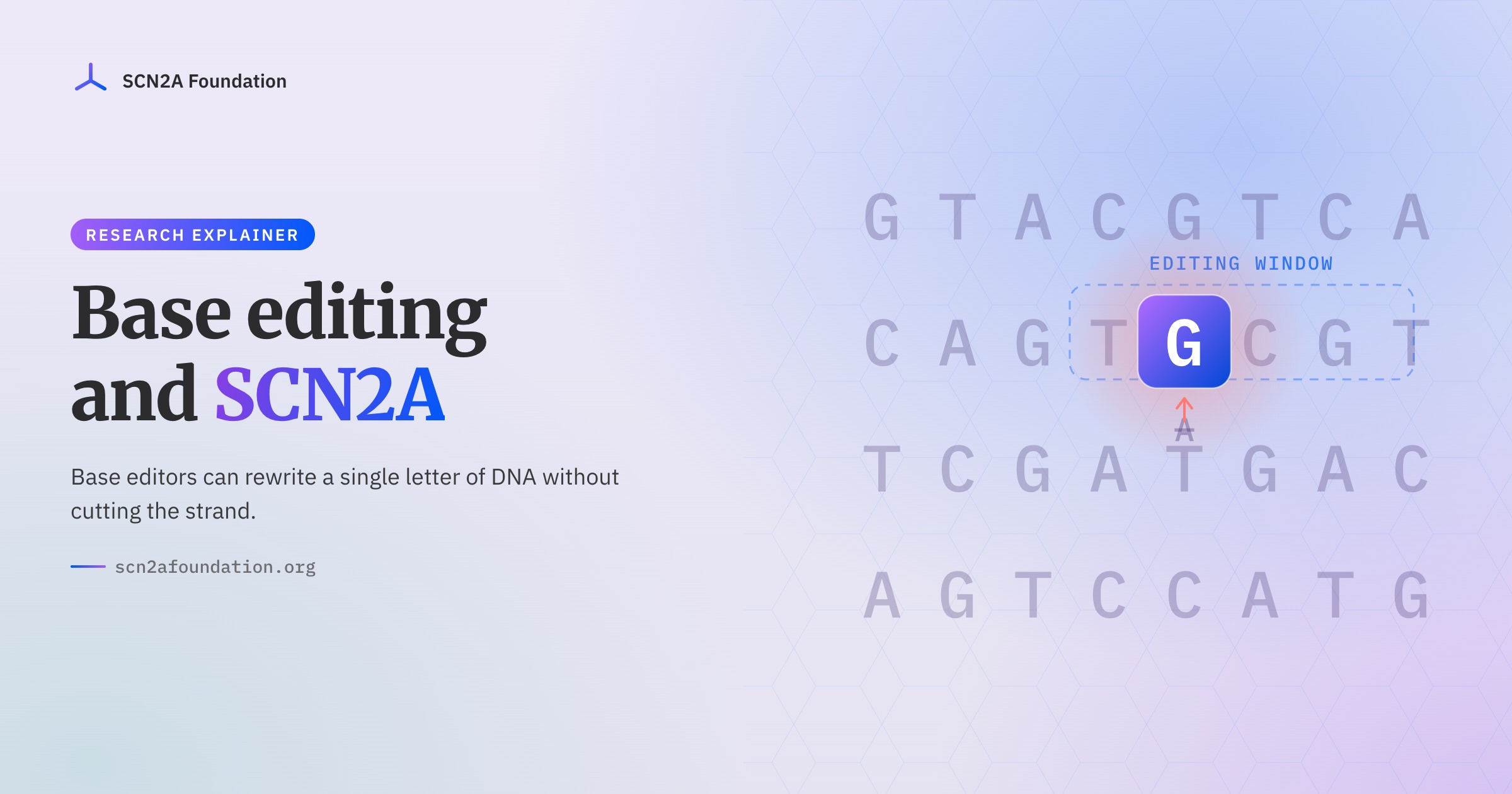
Somewhere in your child's genetic report sits a line of shorthand describing the exact change in the SCN2A gene. In many children, it describes a single position where one chemical letter differs from the expected one. The numbering shifts depending on which reference version of the gene your laboratory used, so two reports can describe the same variant with different numbers.
Over the last decade, researchers have developed base editing as a tool that can change a single DNA letter back to the correct one. This article covers how it works, what it has accomplished so far, and what still needs to happen before it could help a child with an SCN2A-related disorder.
DNA uses four chemical letters: A, T, C, and G. They pair across the two strands of the double helix, A with T and C with G. When one of those pairs changes, geneticists call it a point mutation.
Traditional CRISPR gene editing cuts through both strands of DNA at a chosen spot, then lets the cell repair the damage. Base editing skips the cut. It uses a modified CRISPR protein that has lost the ability to slice through both strands, and fuses that protein to an enzyme called a deaminase. The deaminase reaches the target letter and chemically converts it into a different letter, in place. David Liu's laboratory at Harvard described the technique in Nature in 2016, and the field has built on it since.
Two families of base editors exist. Between them, they cover four of the twelve possible letter-to-letter changes.
Cytosine base editors (CBEs) turn a C•G pair into a T•A pair. Liu's team published these first.
Adenine base editors (ABEs) turn an A•T pair into a G•C pair. Nicole Gaudelli and colleagues reported them in Nature in 2017.
Base editors do not target one letter in perfect isolation. They act across a short window of the sequence they are guided to. Addgene's technical overview puts the window for the most active seventh-generation adenine editor at positions 4 through 7 of the target sequence, with some related editors reaching positions 4 through 9.
That means a second eligible letter sitting beside the target may change too, an effect called bystander editing. It often decides whether a given variant is a realistic target at all.
SCN2A tells your child's cells how to build part of a sodium channel called NaV1.2. That channel sits on the surface of brain cells and controls how they fire. We cover how SCN2A variants affect the NaV1.2 channel in more depth separately.
Whether base editing matters for your child depends on what kind of change they have. Base editing could apply if two things are true:
First, the variant is a single-letter swap. Several variant types qualify. A missense variant changes one letter and changes the protein. A nonsense variant changes one letter and creates a premature stop signal. A splice site variant changes one letter at a junction where the cell reads instructions for assembling the protein. What they share is that the underlying problem is one letter traded for another. Variants caused by missing or extra letters, like frameshifts and insertions, are different. No base editor can put a missing letter back or remove one that does not belong.
Second, the specific letter swap is one of these four:
Roughly four out of five people in the largest published study of SCN2A-related disorders had a single-letter swap. Nobody has yet published an analysis of how many of those fall into the four swaps above, but that is an answerable question, and the data to answer it already exists in variant databases.
If your child's variant meets both criteria, base editing could apply whether it causes gain of function, loss of function, or mixed effects. Those labels shape treatment decisions today, but a base editor does not need to know what the variant does to the channel. It just needs to know what the letter is and what it should be instead.
No study in the published literature has corrected an SCN2A variant with base editing yet. But the groundwork is already being laid.
In 2023, a team at the Broad Institute and collaborating centers used a cytosine base editor to systematically map the SCN2A gene, screening 368 guide RNAs and finding more than 100 that changed how the NaV1.2 channel worked. They were not trying to fix a variant. They were building the instruction manual, learning which positions in the gene matter and what happens when you change them. That is exactly the kind of foundation a future correction effort would build on, and it already exists for SCN2A. You can read more about where this fits in the broader SCN2A research landscape.
No one has taken the next step yet. Everything below describes what base editing has accomplished in other genes, starting with the ones closest to SCN2A.
SCN8A is one of the genes closest to SCN2A, and it builds a closely related sodium channel. In early 2026, a research team reported treating mice carrying a gain-of-function SCN8A variant with an adenine base editor. They split the editing machinery across two viral vectors and injected it into the brain in the first days of life, before seizures would normally begin.
Treatment reduced mutant transcripts by 32 percent, converting them to the normal sequence. Spontaneous seizures stopped completely in 7 of the 11 treated mice monitored by video and EEG, and dropped significantly in 3 more. Treated mice survived significantly longer than untreated ones, and their movement returned to normal levels.
Three treated mice still died early. Sequencing showed editing under 5 percent in each of them, meaning the editor had not reached enough cells to help. Editing efficiency across the entire study stayed below what the technique can theoretically achieve, which means there is room to improve.
One important limitation: every mouse in this study was treated before seizures started. In real life, a child is identified because seizures have already begun. The authors flag this themselves as a question the field still needs to answer.
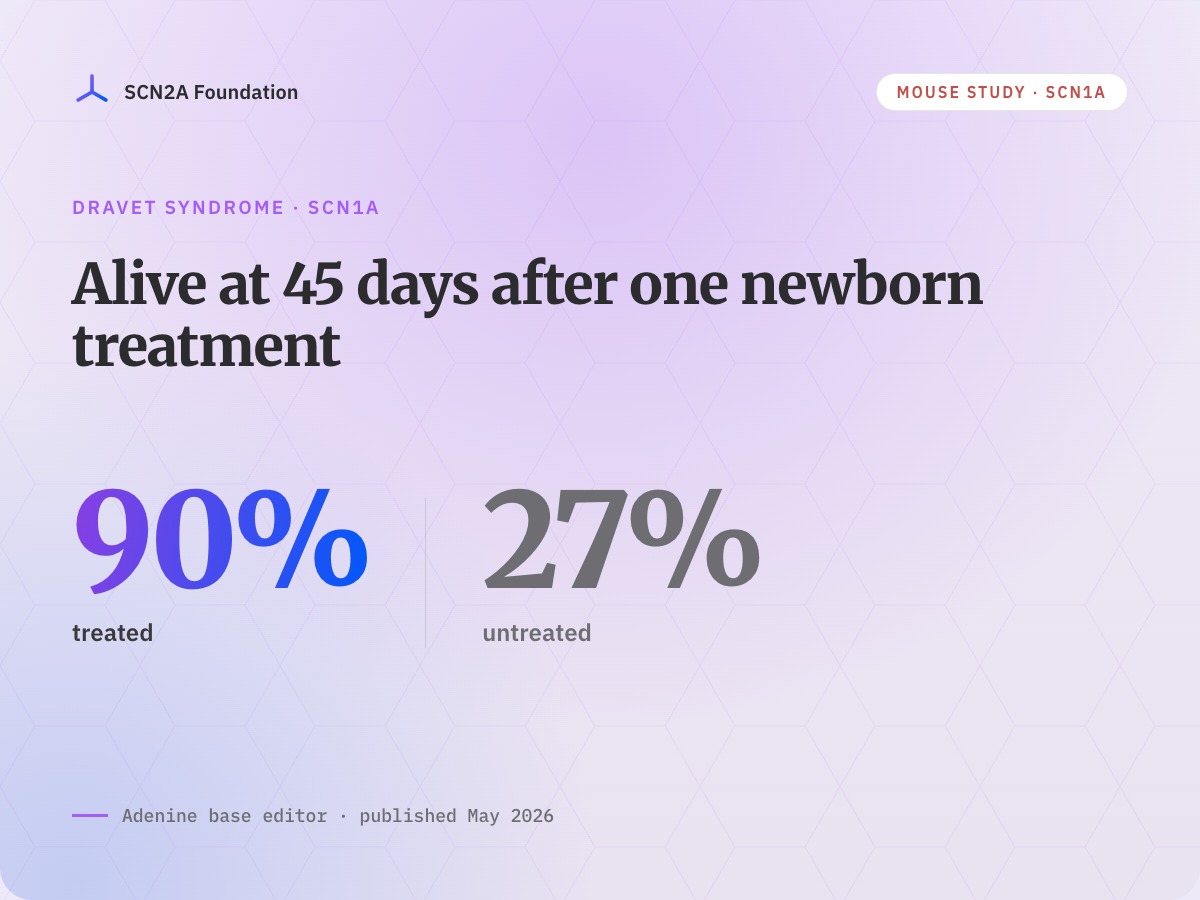
Dravet syndrome is caused by variants in SCN1A, another gene in the same family as SCN2A. Mice with a Dravet-causing variant rarely survive past 45 days. Only 27 percent of untreated animals made it that far. In a study published in May 2026, a team treated newborn mice with an adenine base editor and 90 percent of them were still alive at that point. The editor corrected 97 percent of the mutant RNA in the brain's outer layer. Mice treated at 12 days old, not just as newborns, still benefited.
Base editing has already reached patients in two areas of the body: the liver and the blood.
In a phase 1 trial of 35 people, a base editor delivered to the liver reduced a cholesterol-regulating protein by 51 to 88 percent depending on the dose. A separate program targeting a liver condition called alpha-1 antitrypsin deficiency had treated 29 patients as of February 2026.
Then there is KJ. He was born with a severe urea cycle disorder, and in February 2025 a team at Children's Hospital of Philadelphia gave him a base editor designed for his specific variant. One year later, he was walking and talking.
For sickle cell disease, the approach works differently. Rather than fixing the sickle cell variant directly, the editor changes two other genes so the body starts producing fetal hemoglobin again. Doctors remove blood-forming stem cells, edit them in the lab, and return them after chemotherapy conditioning. Results from 31 patients appeared in April 2026. One patient died of respiratory failure that investigators linked to the chemotherapy conditioning required for the transplant.
These results show that base editing works in people. The next challenge, and the one that matters most for SCN2A, is getting it into the brain.
The brain is protected by something called the blood-brain barrier, a tightly sealed lining of cells around the brain's blood vessels that blocks almost everything from getting through. One 2026 review estimated that 95 percent of treatments have historically been unable to cross it.
That barrier is the single biggest obstacle between the base editing results described above and a child with a brain condition like SCN2A.
There is also a size problem. The delivery vehicles most commonly used in gene therapy, called AAVs, can only carry about 4.7 kilobases of genetic cargo. A base editor is bigger than that. Researchers have solved this by splitting the editor across two separate AAVs and letting the pieces reassemble once they are inside the cell. The SCN8A team described earlier used exactly this approach.
The harder question is which delivery vehicle will work in people. That SCN8A team used a capsid called PhP.eB because it crosses the blood-brain barrier well in mice. But it gets in by binding a protein called LY6A, and researchers have shown that this protein varies between mouse strains and does not exist in primates at all. What works in one strain of lab mouse will not necessarily work in a person.
This is an active area of research across the entire gene therapy field, not just base editing, and solving it would open the door for treatments across a wide range of neurological conditions.
Base editing can only change one letter for another, and only four specific swaps. It cannot insert letters, remove them, or make the other eight letter changes. If your child's SCN2A variant is a frameshift, an insertion, or a deletion, base editing is not the right approach.
Other technologies cover that ground. Prime editing works more like a search-and-replace function and can handle all twelve letter swaps plus small insertions and deletions. When a variant knocks out one copy of the gene entirely, the goal shifts from fixing letters to getting more use out of the working copy. CRISPR activation takes that approach. Gene editing is also not the only path. Small molecules are being studied for SCN2A as well. Which approach fits your child depends on their specific variant, and that is a conversation for their neurologist.
There is no honest timeline to give you. What we can lay out is what the field still needs to solve:
The distance between where things stand today and a treatment for a child is real, but so is the progress. Every item on this list is an active area of research, and the results from SCN8A and Dravet syndrome show that the core technology works in the brain, at least in mice. The question now is engineering, not whether it is possible.
Rare disease research runs on decisions somebody made. To fund a gene. To build a model system. To take on a patient population small enough that no market logic supports it. SCN2A gets studied because families push it forward, and that pressure has to keep coming from somewhere.
There are three ways to add yours. Put your child's variant on the map by signing up for the SCN2A WorldMap, so researchers can see how many people carry which changes. Join the patient registry, which is how trials find the families they need. And donate to help fund the work that turns a single-letter correction from a laboratory result into something a child can actually receive.
Medical Disclaimer: This content is provided for educational and informational purposes only and does not constitute medical advice. The information on this page is not intended to be a substitute for professional medical advice, diagnosis, or treatment. Always seek the guidance of a qualified healthcare provider with any questions you may have regarding a medical condition. Never disregard professional medical advice or delay in seeking it because of something you have read on this website.
Share
Somewhere in your child's genetic report sits a line of shorthand describing the exact change in the SCN2A gene. In many children, it describes a single position where one chemical letter differs from the expected one. The numbering shifts depending on which reference version of the gene your laboratory used, so two reports can describe the same variant with different numbers.
Over the last decade, researchers have developed base editing as a tool that can change a single DNA letter back to the correct one. This article covers how it works, what it has accomplished so far, and what still needs to happen before it could help a child with an SCN2A-related disorder.
DNA uses four chemical letters: A, T, C, and G. They pair across the two strands of the double helix, A with T and C with G. When one of those pairs changes, geneticists call it a point mutation.
Traditional CRISPR gene editing cuts through both strands of DNA at a chosen spot, then lets the cell repair the damage. Base editing skips the cut. It uses a modified CRISPR protein that has lost the ability to slice through both strands, and fuses that protein to an enzyme called a deaminase. The deaminase reaches the target letter and chemically converts it into a different letter, in place. David Liu's laboratory at Harvard described the technique in Nature in 2016, and the field has built on it since.
Two families of base editors exist. Between them, they cover four of the twelve possible letter-to-letter changes.
Cytosine base editors (CBEs) turn a C•G pair into a T•A pair. Liu's team published these first.
Adenine base editors (ABEs) turn an A•T pair into a G•C pair. Nicole Gaudelli and colleagues reported them in Nature in 2017.
Base editors do not target one letter in perfect isolation. They act across a short window of the sequence they are guided to. Addgene's technical overview puts the window for the most active seventh-generation adenine editor at positions 4 through 7 of the target sequence, with some related editors reaching positions 4 through 9.
That means a second eligible letter sitting beside the target may change too, an effect called bystander editing. It often decides whether a given variant is a realistic target at all.
SCN2A tells your child's cells how to build part of a sodium channel called NaV1.2. That channel sits on the surface of brain cells and controls how they fire. We cover how SCN2A variants affect the NaV1.2 channel in more depth separately.
Whether base editing matters for your child depends on what kind of change they have. Base editing could apply if two things are true:
First, the variant is a single-letter swap. Several variant types qualify. A missense variant changes one letter and changes the protein. A nonsense variant changes one letter and creates a premature stop signal. A splice site variant changes one letter at a junction where the cell reads instructions for assembling the protein. What they share is that the underlying problem is one letter traded for another. Variants caused by missing or extra letters, like frameshifts and insertions, are different. No base editor can put a missing letter back or remove one that does not belong.
Second, the specific letter swap is one of these four:
Roughly four out of five people in the largest published study of SCN2A-related disorders had a single-letter swap. Nobody has yet published an analysis of how many of those fall into the four swaps above, but that is an answerable question, and the data to answer it already exists in variant databases.
If your child's variant meets both criteria, base editing could apply whether it causes gain of function, loss of function, or mixed effects. Those labels shape treatment decisions today, but a base editor does not need to know what the variant does to the channel. It just needs to know what the letter is and what it should be instead.
No study in the published literature has corrected an SCN2A variant with base editing yet. But the groundwork is already being laid.
In 2023, a team at the Broad Institute and collaborating centers used a cytosine base editor to systematically map the SCN2A gene, screening 368 guide RNAs and finding more than 100 that changed how the NaV1.2 channel worked. They were not trying to fix a variant. They were building the instruction manual, learning which positions in the gene matter and what happens when you change them. That is exactly the kind of foundation a future correction effort would build on, and it already exists for SCN2A. You can read more about where this fits in the broader SCN2A research landscape.
No one has taken the next step yet. Everything below describes what base editing has accomplished in other genes, starting with the ones closest to SCN2A.
SCN8A is one of the genes closest to SCN2A, and it builds a closely related sodium channel. In early 2026, a research team reported treating mice carrying a gain-of-function SCN8A variant with an adenine base editor. They split the editing machinery across two viral vectors and injected it into the brain in the first days of life, before seizures would normally begin.
Treatment reduced mutant transcripts by 32 percent, converting them to the normal sequence. Spontaneous seizures stopped completely in 7 of the 11 treated mice monitored by video and EEG, and dropped significantly in 3 more. Treated mice survived significantly longer than untreated ones, and their movement returned to normal levels.
Three treated mice still died early. Sequencing showed editing under 5 percent in each of them, meaning the editor had not reached enough cells to help. Editing efficiency across the entire study stayed below what the technique can theoretically achieve, which means there is room to improve.
One important limitation: every mouse in this study was treated before seizures started. In real life, a child is identified because seizures have already begun. The authors flag this themselves as a question the field still needs to answer.
Dravet syndrome is caused by variants in SCN1A, another gene in the same family as SCN2A. Mice with a Dravet-causing variant rarely survive past 45 days. Only 27 percent of untreated animals made it that far. In a study published in May 2026, a team treated newborn mice with an adenine base editor and 90 percent of them were still alive at that point. The editor corrected 97 percent of the mutant RNA in the brain's outer layer. Mice treated at 12 days old, not just as newborns, still benefited.
Base editing has already reached patients in two areas of the body: the liver and the blood.
In a phase 1 trial of 35 people, a base editor delivered to the liver reduced a cholesterol-regulating protein by 51 to 88 percent depending on the dose. A separate program targeting a liver condition called alpha-1 antitrypsin deficiency had treated 29 patients as of February 2026.
Then there is KJ. He was born with a severe urea cycle disorder, and in February 2025 a team at Children's Hospital of Philadelphia gave him a base editor designed for his specific variant. One year later, he was walking and talking.
For sickle cell disease, the approach works differently. Rather than fixing the sickle cell variant directly, the editor changes two other genes so the body starts producing fetal hemoglobin again. Doctors remove blood-forming stem cells, edit them in the lab, and return them after chemotherapy conditioning. Results from 31 patients appeared in April 2026. One patient died of respiratory failure that investigators linked to the chemotherapy conditioning required for the transplant.
These results show that base editing works in people. The next challenge, and the one that matters most for SCN2A, is getting it into the brain.
The brain is protected by something called the blood-brain barrier, a tightly sealed lining of cells around the brain's blood vessels that blocks almost everything from getting through. One 2026 review estimated that 95 percent of treatments have historically been unable to cross it.
That barrier is the single biggest obstacle between the base editing results described above and a child with a brain condition like SCN2A.
There is also a size problem. The delivery vehicles most commonly used in gene therapy, called AAVs, can only carry about 4.7 kilobases of genetic cargo. A base editor is bigger than that. Researchers have solved this by splitting the editor across two separate AAVs and letting the pieces reassemble once they are inside the cell. The SCN8A team described earlier used exactly this approach.
The harder question is which delivery vehicle will work in people. That SCN8A team used a capsid called PhP.eB because it crosses the blood-brain barrier well in mice. But it gets in by binding a protein called LY6A, and researchers have shown that this protein varies between mouse strains and does not exist in primates at all. What works in one strain of lab mouse will not necessarily work in a person.
This is an active area of research across the entire gene therapy field, not just base editing, and solving it would open the door for treatments across a wide range of neurological conditions.
Base editing can only change one letter for another, and only four specific swaps. It cannot insert letters, remove them, or make the other eight letter changes. If your child's SCN2A variant is a frameshift, an insertion, or a deletion, base editing is not the right approach.
Other technologies cover that ground. Prime editing works more like a search-and-replace function and can handle all twelve letter swaps plus small insertions and deletions. When a variant knocks out one copy of the gene entirely, the goal shifts from fixing letters to getting more use out of the working copy. CRISPR activation takes that approach. Gene editing is also not the only path. Small molecules are being studied for SCN2A as well. Which approach fits your child depends on their specific variant, and that is a conversation for their neurologist.
There is no honest timeline to give you. What we can lay out is what the field still needs to solve:
The distance between where things stand today and a treatment for a child is real, but so is the progress. Every item on this list is an active area of research, and the results from SCN8A and Dravet syndrome show that the core technology works in the brain, at least in mice. The question now is engineering, not whether it is possible.
Rare disease research runs on decisions somebody made. To fund a gene. To build a model system. To take on a patient population small enough that no market logic supports it. SCN2A gets studied because families push it forward, and that pressure has to keep coming from somewhere.
There are three ways to add yours. Put your child's variant on the map by signing up for the SCN2A WorldMap, so researchers can see how many people carry which changes. Join the patient registry, which is how trials find the families they need. And donate to help fund the work that turns a single-letter correction from a laboratory result into something a child can actually receive.
Medical Disclaimer: This content is provided for educational and informational purposes only and does not constitute medical advice. The information on this page is not intended to be a substitute for professional medical advice, diagnosis, or treatment. Always seek the guidance of a qualified healthcare provider with any questions you may have regarding a medical condition. Never disregard professional medical advice or delay in seeking it because of something you have read on this website.
Vlad Magdalin

Accelerating research and treatment for SCN2A-related disorders.
Get the latest SCN2A research and community news.