This template was built with Webflow's free Prospero UI Kit. Learn more



Clemizole is an old antihistamine. In 2013, researchers at UCSF gave it to zebrafish bred to model a severe childhood epilepsy. The fish stopped seizing. Nobody had designed clemizole to do that.
Today, clemizole is in Phase 3 clinical trials. That path from a fish tank to a human trial is why a growing number of researchers are spending their careers on one question: could a drug already sitting in a pharmacy work for a condition nobody ever tested it for?
Drug repurposing means taking a medication that is already approved for one condition and testing whether it can treat a different one.
The advantage is speed. The drug already exists. Someone is already manufacturing it, doctors already know what a reasonable dose looks like, and years of patient records show what happens when people take it. A major review in Nature Reviews Drug Discovery put it simply: repurposing uses compounds where much of the early risk has already been removed, which can mean lower costs and shorter timelines.
That word, "de-risked," does not mean safe. When a drug is approved, the approval covers one condition, one dose, and one group of patients. Change the condition, change the dose, or give it to different patients, and you need new evidence that it works and is safe.
Off-label use is a clinician prescribing an approved drug outside its official labeling, based on clinical judgment and whatever evidence exists. It is common in rare diseases, where approved options are few.
Repurposing is a formal research process: screening, preclinical testing, clinical trials, and often a new regulatory approval. The two overlap, because off-label experience is frequently where a repurposing program picks up its first signal. Which raises a question worth holding onto. Who is writing that experience down?
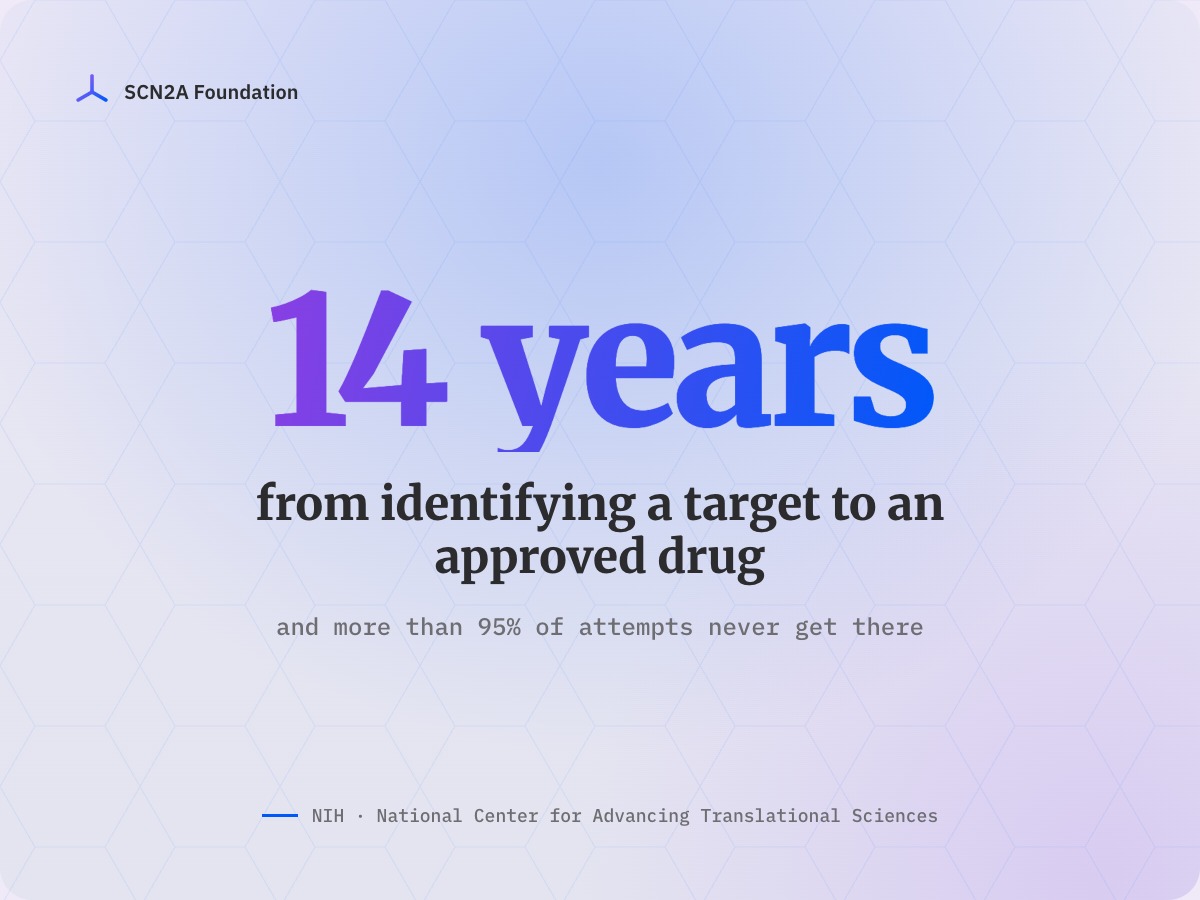
Fourteen years. That is roughly how long it takes to get from identifying a target to an approved drug, according to the NIH's National Center for Advancing Translational Sciences, and more than 95% of attempts never get there.
Against that, a 2024 review in Frontiers in Medicine put the number of rare diseases somewhere between 6,000 and 8,000, with roughly 5% having an approved treatment.
At fourteen years apiece, that queue does not clear. Repurposing lets a program start partway down the track, not at the beginning.
It suits this community for another reason. SCN2A-related disorders are not one condition. They span early-onset epilepsy, later-onset seizures, episodic ataxia, autism, and intellectual disability, and researchers built the therapies furthest along in development around particular categories of variants. A broad drug screen does not begin with a category. It begins with a behavior or a cell and asks what moves it, so it can turn up something for a group nobody designed a program around. What it reaches depends on the biology its models happen to represent, which is why understanding what the SCN2A gene does matters long before any drug enters the picture.
A Yale team published the screen in PNAS in March 2026. They were hunting for drugs that could push the behavior of fish carrying autism-associated gene mutations back toward the ordinary.
They started with 774 FDA-approved drugs and gave them to larval zebrafish. 520 proved non-toxic and produced measurable effects on sensory processing and arousal behaviors, and the team added them to a public database. The team then profiled fish carrying mutations in nine large-effect autism genes, looking for drugs whose behavioral signature ran opposite to a mutant signature.
Two genes got the full candidate screen: SCN2A and DYRK1A.
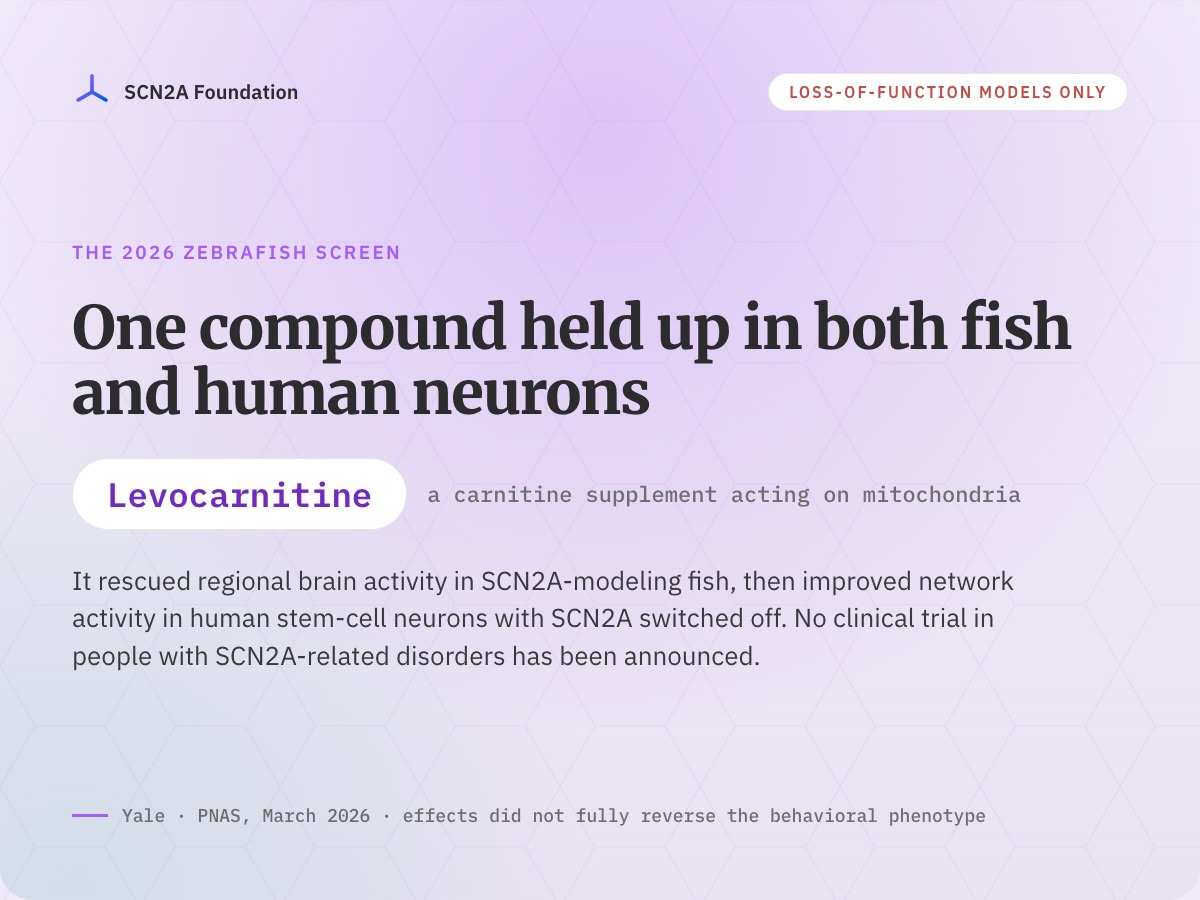
In the SCN2A-modeling fish, the top suppressor was estropipate, an estrogen receptor agonist. For DYRK1A, it was paclitaxel. One compound suppressed both signatures: levocarnitine, a carnitine supplement that acts on mitochondria.
Levocarnitine is where the study got interesting. It rescued regional brain activity deficits and dysregulated lipid metabolic pathways in the mutant fish, then improved network activity in human stem cell-derived neurons in which SCN2A had been switched off, measured on a multielectrode array. The authors described the rescue as holding across systems.
Ellen J. Hoffman, the study's senior author and an associate professor at the Yale Child Study Center, framed the work this way: "Our study highlights the importance of stratifying or subgrouping autism risk genes to identify potential drug candidates using a precision medicine-based approach."
The fish first. The line used to model SCN2A carries a mutation in scn1lab, a gene orthologous to both human SCN1A and human SCN2A, present here as a homozygous deletion. It is the same line the clemizole work used. Useful, and a long way from being a person.
Every system in the study modeled loss of function. The researchers built the human neurons by using CRISPR to switch SCN2A off in a stem cell line. They did not come from a patient, and they carry no specific variant. The paper tested no gain-of-function or mixed-function effects, framing its findings in terms of autism gene loss of function. These results speak to loss-of-function biology.
An outside researcher not involved in the work told a science publication that the compounds "did not completely reverse the behavioral effects," and noted that variants in these genes likely affect several pathways at once.
We could not identify any clinical trial of levocarnitine or estropipate in people with SCN2A-related disorders, and none has been announced.
A version of levocarnitine sells over the counter as a supplement, which makes the prescription form's FDA label worth reading. It lists seizures under adverse reactions. They "have been reported to occur in patients with or without preexisting seizure activity." Where seizure activity already exists, "an increase in seizure frequency and/or severity has been reported." Anything a person with SCN2A takes is a conversation for their neurologist.
The 2013 UCSF screen ran a 320-compound library of FDA-approved, toxicology-tested drugs past zebrafish carrying that same scn1lab mutation, used as a model of Dravet syndrome. Clemizole came out of it, suppressing seizures on both behavioral and electrical measures.
Thirteen years later, it is EPX-100, running two Phase 3 trials, one in Dravet syndrome and one in Lennox-Gastaut. An open-label extension reported in December 2025 followed 18 participants with at least six months of exposure, whose countable motor seizures fell by a median of roughly 50% per 28 days. However, none of that has made it an approved drug yet.
Thirteen years, and still going. That is what the precedent actually looks like.
Fenfluramine came later, and not from a screen. It is FDA-approved for Dravet syndrome and, since March 2022, for Lennox-Gastaut syndrome on a Phase 3 trial of 263 participants. A 2015 follow-up screen from the same laboratory tested it and did find it reduced seizure activity in fish. But the paper says plainly that fenfluramine arrived as an already known candidate from rodent studies and clinical reports. The screen confirmed it. The screen did not find it.
Fenfluramine carries the other lesson too. The FDA pulled it from the US market in 1997 over evidence linking it to valvular heart disease. What eventually came back carries a boxed warning for valvular heart disease and pulmonary arterial hypertension, requires echocardiograms before, during, and after treatment, and reaches patients only through a restricted safety program. An old drug brings its record with it, and that record dates back to 1997.
Everolimus started life as a cancer drug and immunosuppressant. In April 2018, the FDA approved it for seizures associated with tuberous sclerosis complex, on a trial of 366 participants.
Sirolimus kept kidney transplant patients from rejecting their organs before it became, in May 2015, the first FDA-approved treatment for the rare lung disease lymphangioleiomyomatosis, on a trial of 89 patients.
Randomized controlled trials in the new condition got both of them there. Every candidate needs them, including the ones in this article. A signal in a dish is a reason to run the trial, never a substitute for it.
The FDA opened a formal drug repurposing initiative in May 2026 and asked the public to weigh in, naming rare diseases a priority area.
ARPA-H, the federal health research agency, has been funding the computational side. It backed an AI platform that predicts which approved drugs might work against which diseases with up to $48 million in 2024, then returned in February 2026 with up to $76 million more over three years. The plan covers preclinical work on at least 20 repurposing opportunities and clinical trials for 10 candidates.
Those prediction tools have improved quickly. A model published in Nature Medicine in 2024 covers 17,080 diseases, 92% of which have no approved treatments, and matches them against 7,957 drugs. For diseases with no existing treatment, it reported a 49.2% improvement over prior methods in predicting valid uses. Computational benchmarks aren't clinical outcomes, but they are how one candidate gets pulled from thousands and handed to a laboratory.
A screen can only find what its models are built to show, which puts enormous weight on the models.
For SCN2A, that means functional characterization of variants: working out whether a variant leaves the NaV1.2 channel overactive, underactive, or mixed. It also means not over-trusting the label once you have it. A 2026 study of 74 patient cases found that "distinct SCN2A LoF phenotypes cannot be reliably linked to specific biophysical mechanisms." A category is a starting point. A functional read-out is what a screen can actually use.
Then there is natural history data, the long-term record of how children with SCN2A-related disorders develop. Trials measure change against a baseline, and somebody has to build the baseline first.

Somewhere right now, a child with SCN2A is taking something off-label that seems to be helping. That observation usually travels no further than one family and one neurologist.
The FDA and NCATS at the NIH built CURE ID to catch it. The platform is free, and it collects short case reports from patients, care partners, and clinicians describing what happened when they used an approved drug for an unapproved purpose. Researchers use these reports to determine which drugs deserve a proper trial.
In June 2026, the Foundation hosted a community call with Heather Stone, the FDA health science policy analyst behind CURE ID, and worked with her team to open a dedicated SCN2A page on the platform. Families and clinicians can now file reports there.
Filing one is not a treatment recommendation, and the FDA says plainly that individual case reports cannot establish whether a drug is safe or effective for a new use. Enough of them together can show a researcher a pattern worth testing.
None of this competes with the Foundation's other work. It runs alongside the small molecules designed specifically for the NaV1.2 channel, the gene editing approaches under study, and everything else in the research the Foundation follows.
774 drugs went into that Yale screen, and a small number came back out pointing at SCN2A biology. Getting from there to evidence takes funding, model systems, characterized variants, and researchers willing to spend a career on a gene most people have never heard of.
Families supply what nobody else can. Adding your family to the SCN2A WorldMap shows researchers how far this community reaches. Joining the patient registry gives them the characterized variant data that screens like this one run on. And the research itself runs on money, so please consider donating to help move it forward.
Medical Disclaimer: This content is provided for educational and informational purposes only and does not constitute medical advice. The information on this page is not intended to be a substitute for professional medical advice, diagnosis, or treatment. Always seek the guidance of a qualified healthcare provider with any questions you may have regarding a medical condition. Never disregard professional medical advice or delay in seeking it because of something you have read on this website.
Share
Clemizole is an old antihistamine. In 2013, researchers at UCSF gave it to zebrafish bred to model a severe childhood epilepsy. The fish stopped seizing. Nobody had designed clemizole to do that.
Today, clemizole is in Phase 3 clinical trials. That path from a fish tank to a human trial is why a growing number of researchers are spending their careers on one question: could a drug already sitting in a pharmacy work for a condition nobody ever tested it for?
Drug repurposing means taking a medication that is already approved for one condition and testing whether it can treat a different one.
The advantage is speed. The drug already exists. Someone is already manufacturing it, doctors already know what a reasonable dose looks like, and years of patient records show what happens when people take it. A major review in Nature Reviews Drug Discovery put it simply: repurposing uses compounds where much of the early risk has already been removed, which can mean lower costs and shorter timelines.
That word, "de-risked," does not mean safe. When a drug is approved, the approval covers one condition, one dose, and one group of patients. Change the condition, change the dose, or give it to different patients, and you need new evidence that it works and is safe.
Off-label use is a clinician prescribing an approved drug outside its official labeling, based on clinical judgment and whatever evidence exists. It is common in rare diseases, where approved options are few.
Repurposing is a formal research process: screening, preclinical testing, clinical trials, and often a new regulatory approval. The two overlap, because off-label experience is frequently where a repurposing program picks up its first signal. Which raises a question worth holding onto. Who is writing that experience down?
Fourteen years. That is roughly how long it takes to get from identifying a target to an approved drug, according to the NIH's National Center for Advancing Translational Sciences, and more than 95% of attempts never get there.
Against that, a 2024 review in Frontiers in Medicine put the number of rare diseases somewhere between 6,000 and 8,000, with roughly 5% having an approved treatment.
At fourteen years apiece, that queue does not clear. Repurposing lets a program start partway down the track, not at the beginning.
It suits this community for another reason. SCN2A-related disorders are not one condition. They span early-onset epilepsy, later-onset seizures, episodic ataxia, autism, and intellectual disability, and researchers built the therapies furthest along in development around particular categories of variants. A broad drug screen does not begin with a category. It begins with a behavior or a cell and asks what moves it, so it can turn up something for a group nobody designed a program around. What it reaches depends on the biology its models happen to represent, which is why understanding what the SCN2A gene does matters long before any drug enters the picture.
A Yale team published the screen in PNAS in March 2026. They were hunting for drugs that could push the behavior of fish carrying autism-associated gene mutations back toward the ordinary.
They started with 774 FDA-approved drugs and gave them to larval zebrafish. 520 proved non-toxic and produced measurable effects on sensory processing and arousal behaviors, and the team added them to a public database. The team then profiled fish carrying mutations in nine large-effect autism genes, looking for drugs whose behavioral signature ran opposite to a mutant signature.
Two genes got the full candidate screen: SCN2A and DYRK1A.
In the SCN2A-modeling fish, the top suppressor was estropipate, an estrogen receptor agonist. For DYRK1A, it was paclitaxel. One compound suppressed both signatures: levocarnitine, a carnitine supplement that acts on mitochondria.
Levocarnitine is where the study got interesting. It rescued regional brain activity deficits and dysregulated lipid metabolic pathways in the mutant fish, then improved network activity in human stem cell-derived neurons in which SCN2A had been switched off, measured on a multielectrode array. The authors described the rescue as holding across systems.
Ellen J. Hoffman, the study's senior author and an associate professor at the Yale Child Study Center, framed the work this way: "Our study highlights the importance of stratifying or subgrouping autism risk genes to identify potential drug candidates using a precision medicine-based approach."
The fish first. The line used to model SCN2A carries a mutation in scn1lab, a gene orthologous to both human SCN1A and human SCN2A, present here as a homozygous deletion. It is the same line the clemizole work used. Useful, and a long way from being a person.
Every system in the study modeled loss of function. The researchers built the human neurons by using CRISPR to switch SCN2A off in a stem cell line. They did not come from a patient, and they carry no specific variant. The paper tested no gain-of-function or mixed-function effects, framing its findings in terms of autism gene loss of function. These results speak to loss-of-function biology.
An outside researcher not involved in the work told a science publication that the compounds "did not completely reverse the behavioral effects," and noted that variants in these genes likely affect several pathways at once.
We could not identify any clinical trial of levocarnitine or estropipate in people with SCN2A-related disorders, and none has been announced.
A version of levocarnitine sells over the counter as a supplement, which makes the prescription form's FDA label worth reading. It lists seizures under adverse reactions. They "have been reported to occur in patients with or without preexisting seizure activity." Where seizure activity already exists, "an increase in seizure frequency and/or severity has been reported." Anything a person with SCN2A takes is a conversation for their neurologist.
The 2013 UCSF screen ran a 320-compound library of FDA-approved, toxicology-tested drugs past zebrafish carrying that same scn1lab mutation, used as a model of Dravet syndrome. Clemizole came out of it, suppressing seizures on both behavioral and electrical measures.
Thirteen years later, it is EPX-100, running two Phase 3 trials, one in Dravet syndrome and one in Lennox-Gastaut. An open-label extension reported in December 2025 followed 18 participants with at least six months of exposure, whose countable motor seizures fell by a median of roughly 50% per 28 days. However, none of that has made it an approved drug yet.
Thirteen years, and still going. That is what the precedent actually looks like.
Fenfluramine came later, and not from a screen. It is FDA-approved for Dravet syndrome and, since March 2022, for Lennox-Gastaut syndrome on a Phase 3 trial of 263 participants. A 2015 follow-up screen from the same laboratory tested it and did find it reduced seizure activity in fish. But the paper says plainly that fenfluramine arrived as an already known candidate from rodent studies and clinical reports. The screen confirmed it. The screen did not find it.
Fenfluramine carries the other lesson too. The FDA pulled it from the US market in 1997 over evidence linking it to valvular heart disease. What eventually came back carries a boxed warning for valvular heart disease and pulmonary arterial hypertension, requires echocardiograms before, during, and after treatment, and reaches patients only through a restricted safety program. An old drug brings its record with it, and that record dates back to 1997.
Everolimus started life as a cancer drug and immunosuppressant. In April 2018, the FDA approved it for seizures associated with tuberous sclerosis complex, on a trial of 366 participants.
Sirolimus kept kidney transplant patients from rejecting their organs before it became, in May 2015, the first FDA-approved treatment for the rare lung disease lymphangioleiomyomatosis, on a trial of 89 patients.
Randomized controlled trials in the new condition got both of them there. Every candidate needs them, including the ones in this article. A signal in a dish is a reason to run the trial, never a substitute for it.
The FDA opened a formal drug repurposing initiative in May 2026 and asked the public to weigh in, naming rare diseases a priority area.
ARPA-H, the federal health research agency, has been funding the computational side. It backed an AI platform that predicts which approved drugs might work against which diseases with up to $48 million in 2024, then returned in February 2026 with up to $76 million more over three years. The plan covers preclinical work on at least 20 repurposing opportunities and clinical trials for 10 candidates.
Those prediction tools have improved quickly. A model published in Nature Medicine in 2024 covers 17,080 diseases, 92% of which have no approved treatments, and matches them against 7,957 drugs. For diseases with no existing treatment, it reported a 49.2% improvement over prior methods in predicting valid uses. Computational benchmarks aren't clinical outcomes, but they are how one candidate gets pulled from thousands and handed to a laboratory.
A screen can only find what its models are built to show, which puts enormous weight on the models.
For SCN2A, that means functional characterization of variants: working out whether a variant leaves the NaV1.2 channel overactive, underactive, or mixed. It also means not over-trusting the label once you have it. A 2026 study of 74 patient cases found that "distinct SCN2A LoF phenotypes cannot be reliably linked to specific biophysical mechanisms." A category is a starting point. A functional read-out is what a screen can actually use.
Then there is natural history data, the long-term record of how children with SCN2A-related disorders develop. Trials measure change against a baseline, and somebody has to build the baseline first.
Somewhere right now, a child with SCN2A is taking something off-label that seems to be helping. That observation usually travels no further than one family and one neurologist.
The FDA and NCATS at the NIH built CURE ID to catch it. The platform is free, and it collects short case reports from patients, care partners, and clinicians describing what happened when they used an approved drug for an unapproved purpose. Researchers use these reports to determine which drugs deserve a proper trial.
In June 2026, the Foundation hosted a community call with Heather Stone, the FDA health science policy analyst behind CURE ID, and worked with her team to open a dedicated SCN2A page on the platform. Families and clinicians can now file reports there.
Filing one is not a treatment recommendation, and the FDA says plainly that individual case reports cannot establish whether a drug is safe or effective for a new use. Enough of them together can show a researcher a pattern worth testing.
None of this competes with the Foundation's other work. It runs alongside the small molecules designed specifically for the NaV1.2 channel, the gene editing approaches under study, and everything else in the research the Foundation follows.
774 drugs went into that Yale screen, and a small number came back out pointing at SCN2A biology. Getting from there to evidence takes funding, model systems, characterized variants, and researchers willing to spend a career on a gene most people have never heard of.
Families supply what nobody else can. Adding your family to the SCN2A WorldMap shows researchers how far this community reaches. Joining the patient registry gives them the characterized variant data that screens like this one run on. And the research itself runs on money, so please consider donating to help move it forward.
Medical Disclaimer: This content is provided for educational and informational purposes only and does not constitute medical advice. The information on this page is not intended to be a substitute for professional medical advice, diagnosis, or treatment. Always seek the guidance of a qualified healthcare provider with any questions you may have regarding a medical condition. Never disregard professional medical advice or delay in seeking it because of something you have read on this website.
Vlad Magdalin

Accelerating research and treatment for SCN2A-related disorders.
Get the latest SCN2A research and community news.