This template was built with Webflow's free Prospero UI Kit. Learn more



A boy who had been referred to hospice at age two took his first independent steps at 15.
He had lived with near daily seizures that did not respond to more than ten different medications. He was nonverbal and unable to walk. Then researchers built a medicine designed around his own genetic makeup, using one small detail in it that let them tell his two copies of the SCN2A gene apart.
That medicine is called an individualized antisense oligonucleotide, or individualized ASO. His results and those of one other child were published in Nature Medicine on July 21, 2026, by a team led by the University of California San Diego and Rady Children’s Institute for Genomic Medicine.
This guide explains what an individualized SCN2A ASO actually is, what the study did and did not show, and what would have to happen for this approach to reach more families.
An antisense oligonucleotide (ASO) is a short, lab-made strand of genetic material. Think of it as a very precise instruction slip. It binds a specific RNA molecule in the cell and changes what happens to that RNA.
ASOs do not all work the same way. Some change how a gene’s instructions get assembled. Others, including both ASOs in this study, tag one specific version of those instructions so the cell breaks it down before any protein is made.
ASOs are not new. They are already approved for conditions including spinal muscular atrophy and amyotrophic lateral sclerosis. What is new is using them for variants so rare that only a handful of people worldwide carry them.
The SCN2A gene provides instructions for building the NaV1.2 sodium channel, a gate on brain cells that controls how sodium moves in and out. That flow shapes how easily a neuron fires.
In a gain-of-function (GOF) variant, the channel is overactive. Neurons fire too easily, which can lead to seizures that begin very early in life. In a loss-of-function (LOF) variant, the channel is underactive, and the picture more often involves autism and intellectual disability, sometimes without epilepsy. Some variants are mixed function, showing features of both. You can read more about how SCN2A variants affect the NaV1.2 channel in our overview.
This distinction matters enormously here. An ASO that lowers SCN2A production is designed to calm an overactive channel. That logic applies to gain-of-function variants, and to selected mixed-function variants where reducing the faulty copy makes mechanistic sense. It is not automatic for every variant labeled mixed function, because the specific behavior of each change still matters. It does not apply to loss-of-function variants, where less SCN2A activity is the problem rather than the solution. Any decision about which approach fits a specific child belongs to that child’s medical team, working from confirmed genetic and functional test results.
Most medicines are built for populations. A company identifies a shared disease mechanism, develops one compound, tests it in a trial, and if it works, the same product goes to everyone who qualifies.
An individualized ASO flips that model. It is designed, manufactured, and tested for one named person, based on that person’s specific genetic sequence.
The idea traces back to 2019, when researchers developed a customized ASO called milasen for a single child with a rare form of Batten disease. From first contact to the start of an n-of-1 study took about a year. That case showed the timeline was possible. It did not show the approach could be repeated at scale.
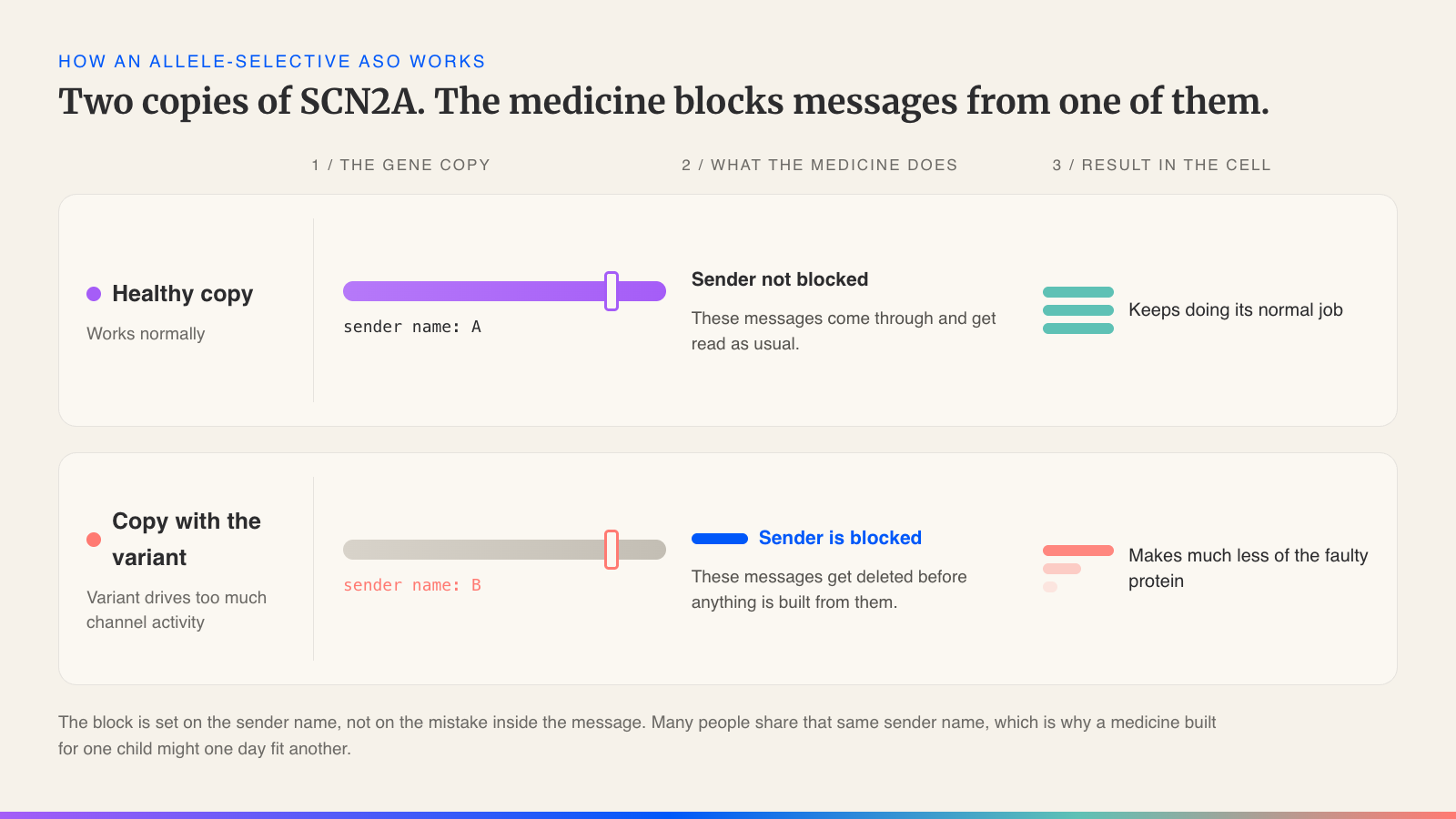
Most children with SCN2A-related disorders have two copies of the gene. One works normally. The other carries the changed variant. When too much channel activity is driving the problem, one strategy is to lower production from the faulty copy and leave the healthy one working. That is what both ASOs in this study were targeting.
The hard part is that the two copies are nearly identical. The disease-causing change is tiny and unique to that child, so building a tool that grabs it directly is not practical.
So the researchers looked for an easier target. Each boy carried a SNP, a common single-letter spelling difference that causes no harm on its own. It sat inside his SCN2A gene, and it read one way on the faulty copy and a different way on the healthy copy. That harmless letter became a label.
Each ASO was built to spot that letter on the faulty copy. Think of it like blocking a sender on your phone. The medicine does not read the message. It checks who sent it, and messages from the blocked copy get deleted before anything is built from them. Messages from the healthy copy come through as usual. That is what allele-selective means.
Note that the ASO does not attach to the disease-causing change itself, only to a common marker sitting nearby on the same copy. Plenty of other children carry that same marker. That is what makes this approach shareable, and we will come back to it.
Two boys took part, in two separate single-patient trials.
Patient 1 was 9 years old. He had a gain-of-function SCN2A variant, seizures that began in the newborn period, severe intellectual disability, and autism. He was nonverbal, had frequent seizures despite trying more than ten antiseizure medications, and needed rescue medication about twice a week.
Patient 2 was 14 years old. He had a mixed gain-of-function and loss-of-function variant. His spasms began at eight months. He was nonverbal, unable to walk, living with significant movement difficulties and severe gastrointestinal problems.
Both received their ASO by intrathecal injection, a lumbar puncture that delivers medicine into the fluid around the spinal cord, roughly every two to three months.
The results:
Two patients is two patients. There was no control group and no placebo. Each boy was compared against his own history before treatment, which is a reasonable design for an ultra-rare condition but a weaker form of evidence than a randomized trial. The study was open-label, meaning families and clinicians knew treatment was being given. Follow-up is ongoing, and the researchers themselves state that long-term data are needed before anyone can confirm whether these ASOs truly change the course of the disease.
The authors also raise a sobering point. In conditions where brain networks have already been shaped over years, there may be limits to how much any therapy can reverse. Earlier treatment may matter a great deal.
Elsunersen is an ASO developed by Praxis Precision Medicines for a defined population: children with early-seizure-onset SCN2A-DEE caused by gain-of-function variants. It moved through conventional trials, received FDA Breakthrough Therapy Designation in June 2026, and is enrolling in a pivotal study. One product, many eligible patients.
Individualized ASOs serve the people that model cannot reach. The two boys in the Nature Medicine study had variants rare enough that conventional drug economics do not support building a commercial product aimed at their specific change.
These approaches are complementary.
This is the real question, and the honest answer is: not yet, but the path is becoming visible.
A therapy built for one person helps one person. That does not scale, and it does not sustain.
But the study contains a finding that deserves far more attention than it has received. The ASOs were targeted at common, harmless spelling differences in the gene, not at the rare variants themselves. Those common differences are shared by many people.
The team analyzed 19 children with SCN2A-related disorders who had been diagnosed through rapid whole-genome sequencing. Three of them, or 16%, carried the genetic arrangement that would allow them to use the very same ASO built for Patient 2. Note that the 16% is not an eligibility rate for the SCN2A population. It came from 19 children at a single center, matched to one specific ASO. Real use would still depend on what the variant does, how the variant and the marker sit together on the chromosome, and other clinical considerations.
Even so, it is the bridge. It turns a one-person drug into a small-group drug.
Several things, in parallel.
Faster diagnosis. Rapid whole-genome sequencing can identify the genetic cause within days of a first seizure. Any therapy aimed at protecting development has to arrive before too much time passes.
Functional testing where it counts. Knowing a variant exists is not enough. Someone has to determine whether it causes gain of function, loss of function, or mixed effects. Many families are living with a variant of uncertain significance and no functional answer.
Regulatory frameworks built for tiny populations. The FDA issued draft guidance in 2021 on how sponsor-investigators should submit applications for individualized ASOs aimed at severely debilitating or life-threatening diseases. In February 2026 it went further, publishing a draft framework for individualized therapies that expressly covers RNA-based treatments including ASOs, and that describes how developers might show effectiveness when a conventional randomized trial is not workable. These are drafts and none is legally binding. The FDA has also been clear that the 2026 framework does not create a new approval pathway or lower the standard. Even so, a field that had no map now has one being drawn.
Manufacturing and cost. Every bespoke ASO requires its own safety testing and its own production run. The nonprofit n-Lorem Foundation, which developed both ASOs in this study, provides these medicines to eligible patients at no cost. Its leadership has argued publicly that new commercial and financing models are needed, because conventional pricing cannot recover development costs for a drug with one or two eligible patients.
Sustained funding. Research at UC San Diego for this work was supported in part by the California Institute for Regenerative Medicine. Public and philanthropic funding carried this to publication. It will have to carry it further.
Nothing here is a treatment recommendation. These are reasonable steps to discuss with your child’s care team.
Registries are not paperwork. When investigators went looking for children who might share an ASO, they searched a sequenced cohort. Visibility is what makes a family findable.
Is individualized ASO therapy available to my child today?
Not as an approved or standard treatment. These remain investigational and are delivered through single-patient research protocols. Programs do exist and both studies described here are still active, so eligibility is a fair question for your child’s care team. Qualifying depends on the specific variant, its functional effect, disease severity, and whether a suitable ASO can be designed.
Is an ASO a cure for SCN2A?
No. The ASOs described in this study reduce production from the disease-causing gene copy. They do not correct or remove the variant, and treatment is ongoing rather than one time.
Does this knockdown approach work for loss-of-function variants?
The approach described in this study was designed for gain-of-function and mixed-function variants. Different strategies are being researched for loss of function.
How is the medicine given?
By intrathecal injection into the fluid around the spinal cord, repeated every few months in this study.
Why can’t every child get a personalized ASO?
Design feasibility, functional characterization, manufacturing capacity, safety testing requirements, and funding all limit how many can be made today. Widening that number is the work ahead.
Two families had run out of options and kept looking anyway. What they found is not a cure, and both studies are still running. But one boy is walking. Another is off a medication he had needed since infancy. And the method behind both of them may one day reach children they will never meet. That happened because science, regulation, and philanthropy lined up at one moment for two families. Every SCN2A family deserves that alignment, and it does not arrive on its own. Please consider making a donation to help fund the research that turns one child’s breakthrough into a path for many.
This content is provided for educational and informational purposes only and does not constitute medical advice. The information on this page is not intended to be a substitute for professional medical advice, diagnosis, or treatment. Always seek the guidance of a qualified healthcare provider with any questions you may have regarding a medical condition. Never disregard professional medical advice or delay in seeking it because of something you have read on this website.
Share
A boy who had been referred to hospice at age two took his first independent steps at 15.
He had lived with near daily seizures that did not respond to more than ten different medications. He was nonverbal and unable to walk. Then researchers built a medicine designed around his own genetic makeup, using one small detail in it that let them tell his two copies of the SCN2A gene apart.
That medicine is called an individualized antisense oligonucleotide, or individualized ASO. His results and those of one other child were published in Nature Medicine on July 21, 2026, by a team led by the University of California San Diego and Rady Children’s Institute for Genomic Medicine.
This guide explains what an individualized SCN2A ASO actually is, what the study did and did not show, and what would have to happen for this approach to reach more families.
An antisense oligonucleotide (ASO) is a short, lab-made strand of genetic material. Think of it as a very precise instruction slip. It binds a specific RNA molecule in the cell and changes what happens to that RNA.
ASOs do not all work the same way. Some change how a gene’s instructions get assembled. Others, including both ASOs in this study, tag one specific version of those instructions so the cell breaks it down before any protein is made.
ASOs are not new. They are already approved for conditions including spinal muscular atrophy and amyotrophic lateral sclerosis. What is new is using them for variants so rare that only a handful of people worldwide carry them.
The SCN2A gene provides instructions for building the NaV1.2 sodium channel, a gate on brain cells that controls how sodium moves in and out. That flow shapes how easily a neuron fires.
In a gain-of-function (GOF) variant, the channel is overactive. Neurons fire too easily, which can lead to seizures that begin very early in life. In a loss-of-function (LOF) variant, the channel is underactive, and the picture more often involves autism and intellectual disability, sometimes without epilepsy. Some variants are mixed function, showing features of both. You can read more about how SCN2A variants affect the NaV1.2 channel in our overview.
This distinction matters enormously here. An ASO that lowers SCN2A production is designed to calm an overactive channel. That logic applies to gain-of-function variants, and to selected mixed-function variants where reducing the faulty copy makes mechanistic sense. It is not automatic for every variant labeled mixed function, because the specific behavior of each change still matters. It does not apply to loss-of-function variants, where less SCN2A activity is the problem rather than the solution. Any decision about which approach fits a specific child belongs to that child’s medical team, working from confirmed genetic and functional test results.
Most medicines are built for populations. A company identifies a shared disease mechanism, develops one compound, tests it in a trial, and if it works, the same product goes to everyone who qualifies.
An individualized ASO flips that model. It is designed, manufactured, and tested for one named person, based on that person’s specific genetic sequence.
The idea traces back to 2019, when researchers developed a customized ASO called milasen for a single child with a rare form of Batten disease. From first contact to the start of an n-of-1 study took about a year. That case showed the timeline was possible. It did not show the approach could be repeated at scale.
Most children with SCN2A-related disorders have two copies of the gene. One works normally. The other carries the changed variant. When too much channel activity is driving the problem, one strategy is to lower production from the faulty copy and leave the healthy one working. That is what both ASOs in this study were targeting.
The hard part is that the two copies are nearly identical. The disease-causing change is tiny and unique to that child, so building a tool that grabs it directly is not practical.
So the researchers looked for an easier target. Each boy carried a SNP, a common single-letter spelling difference that causes no harm on its own. It sat inside his SCN2A gene, and it read one way on the faulty copy and a different way on the healthy copy. That harmless letter became a label.
Each ASO was built to spot that letter on the faulty copy. Think of it like blocking a sender on your phone. The medicine does not read the message. It checks who sent it, and messages from the blocked copy get deleted before anything is built from them. Messages from the healthy copy come through as usual. That is what allele-selective means.
Note that the ASO does not attach to the disease-causing change itself, only to a common marker sitting nearby on the same copy. Plenty of other children carry that same marker. That is what makes this approach shareable, and we will come back to it.
Two boys took part, in two separate single-patient trials.
Patient 1 was 9 years old. He had a gain-of-function SCN2A variant, seizures that began in the newborn period, severe intellectual disability, and autism. He was nonverbal, had frequent seizures despite trying more than ten antiseizure medications, and needed rescue medication about twice a week.
Patient 2 was 14 years old. He had a mixed gain-of-function and loss-of-function variant. His spasms began at eight months. He was nonverbal, unable to walk, living with significant movement difficulties and severe gastrointestinal problems.
Both received their ASO by intrathecal injection, a lumbar puncture that delivers medicine into the fluid around the spinal cord, roughly every two to three months.
The results:
Two patients is two patients. There was no control group and no placebo. Each boy was compared against his own history before treatment, which is a reasonable design for an ultra-rare condition but a weaker form of evidence than a randomized trial. The study was open-label, meaning families and clinicians knew treatment was being given. Follow-up is ongoing, and the researchers themselves state that long-term data are needed before anyone can confirm whether these ASOs truly change the course of the disease.
The authors also raise a sobering point. In conditions where brain networks have already been shaped over years, there may be limits to how much any therapy can reverse. Earlier treatment may matter a great deal.
Elsunersen is an ASO developed by Praxis Precision Medicines for a defined population: children with early-seizure-onset SCN2A-DEE caused by gain-of-function variants. It moved through conventional trials, received FDA Breakthrough Therapy Designation in June 2026, and is enrolling in a pivotal study. One product, many eligible patients.
Individualized ASOs serve the people that model cannot reach. The two boys in the Nature Medicine study had variants rare enough that conventional drug economics do not support building a commercial product aimed at their specific change.
These approaches are complementary.
This is the real question, and the honest answer is: not yet, but the path is becoming visible.
A therapy built for one person helps one person. That does not scale, and it does not sustain.
But the study contains a finding that deserves far more attention than it has received. The ASOs were targeted at common, harmless spelling differences in the gene, not at the rare variants themselves. Those common differences are shared by many people.
The team analyzed 19 children with SCN2A-related disorders who had been diagnosed through rapid whole-genome sequencing. Three of them, or 16%, carried the genetic arrangement that would allow them to use the very same ASO built for Patient 2. Note that the 16% is not an eligibility rate for the SCN2A population. It came from 19 children at a single center, matched to one specific ASO. Real use would still depend on what the variant does, how the variant and the marker sit together on the chromosome, and other clinical considerations.
Even so, it is the bridge. It turns a one-person drug into a small-group drug.
Several things, in parallel.
Faster diagnosis. Rapid whole-genome sequencing can identify the genetic cause within days of a first seizure. Any therapy aimed at protecting development has to arrive before too much time passes.
Functional testing where it counts. Knowing a variant exists is not enough. Someone has to determine whether it causes gain of function, loss of function, or mixed effects. Many families are living with a variant of uncertain significance and no functional answer.
Regulatory frameworks built for tiny populations. The FDA issued draft guidance in 2021 on how sponsor-investigators should submit applications for individualized ASOs aimed at severely debilitating or life-threatening diseases. In February 2026 it went further, publishing a draft framework for individualized therapies that expressly covers RNA-based treatments including ASOs, and that describes how developers might show effectiveness when a conventional randomized trial is not workable. These are drafts and none is legally binding. The FDA has also been clear that the 2026 framework does not create a new approval pathway or lower the standard. Even so, a field that had no map now has one being drawn.
Manufacturing and cost. Every bespoke ASO requires its own safety testing and its own production run. The nonprofit n-Lorem Foundation, which developed both ASOs in this study, provides these medicines to eligible patients at no cost. Its leadership has argued publicly that new commercial and financing models are needed, because conventional pricing cannot recover development costs for a drug with one or two eligible patients.
Sustained funding. Research at UC San Diego for this work was supported in part by the California Institute for Regenerative Medicine. Public and philanthropic funding carried this to publication. It will have to carry it further.
Nothing here is a treatment recommendation. These are reasonable steps to discuss with your child’s care team.
Registries are not paperwork. When investigators went looking for children who might share an ASO, they searched a sequenced cohort. Visibility is what makes a family findable.
Is individualized ASO therapy available to my child today?
Not as an approved or standard treatment. These remain investigational and are delivered through single-patient research protocols. Programs do exist and both studies described here are still active, so eligibility is a fair question for your child’s care team. Qualifying depends on the specific variant, its functional effect, disease severity, and whether a suitable ASO can be designed.
Is an ASO a cure for SCN2A?
No. The ASOs described in this study reduce production from the disease-causing gene copy. They do not correct or remove the variant, and treatment is ongoing rather than one time.
Does this knockdown approach work for loss-of-function variants?
The approach described in this study was designed for gain-of-function and mixed-function variants. Different strategies are being researched for loss of function.
How is the medicine given?
By intrathecal injection into the fluid around the spinal cord, repeated every few months in this study.
Why can’t every child get a personalized ASO?
Design feasibility, functional characterization, manufacturing capacity, safety testing requirements, and funding all limit how many can be made today. Widening that number is the work ahead.
Two families had run out of options and kept looking anyway. What they found is not a cure, and both studies are still running. But one boy is walking. Another is off a medication he had needed since infancy. And the method behind both of them may one day reach children they will never meet. That happened because science, regulation, and philanthropy lined up at one moment for two families. Every SCN2A family deserves that alignment, and it does not arrive on its own. Please consider making a donation to help fund the research that turns one child’s breakthrough into a path for many.
This content is provided for educational and informational purposes only and does not constitute medical advice. The information on this page is not intended to be a substitute for professional medical advice, diagnosis, or treatment. Always seek the guidance of a qualified healthcare provider with any questions you may have regarding a medical condition. Never disregard professional medical advice or delay in seeking it because of something you have read on this website.
Vlad Magdalin

Accelerating research and treatment for SCN2A-related disorders.
Get the latest SCN2A research and community news.