This template was built with Webflow's free Prospero UI Kit. Learn more


When your child is diagnosed with an SCN2A-related disorder, one of the hardest parts is the silence. You search online. You scroll through Facebook groups at two in the morning. You ask your neurologist. And most of the time, you cannot find a single other family whose child carries the same specific variant as yours.
That silence is not because other families do not exist. They do. Somewhere in the world, another parent is awake right now asking the same questions you are. What medications helped. What seizure patterns looked like at this age. What developmental milestones to expect (or let go of). But the systems meant to collect this kind of information were never designed to connect one family directly to another.
Clinical registries and natural history studies collect valuable data for research, and that work is essential. These tools help scientists and regulators understand how SCN2A-related disorders affect people over time. However, the data inside them is anonymized, access is governed by institutional review boards (IRBs), and families often have no practical way to locate or contact each other. The information exists. It is just locked behind layers of process that were never built with parent-to-parent connection in mind.
For a condition where mutation type shapes so much of a child's experience, that gap between families is painful. A parent of a child with a gain-of-function variant faces different medication questions than a parent of a child with loss-of-function. The more specific the variant, the more valuable it is to hear from someone living with the same one. And until now, finding that person has been almost entirely a matter of luck.
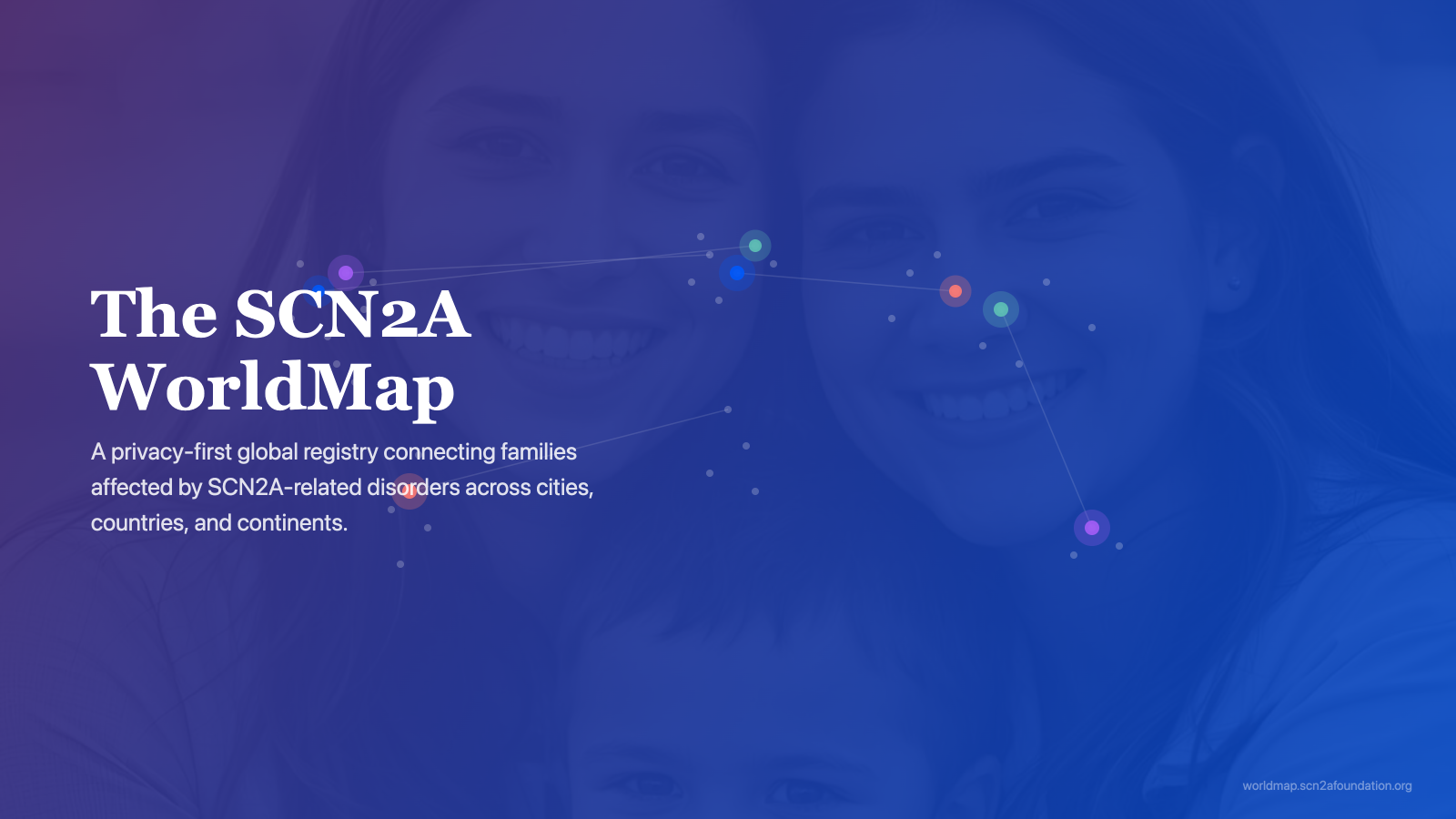
The SCN2A World Map is a global family registry built by the SCN2A Foundation. It is an interactive, privacy-first tool designed to do one thing traditional registries cannot: help families affected by SCN2A-related disorders find each other across cities, countries, and continents.
Each registered family appears as a pin on a live map. Pins display only the information a family chooses to share. Visitors can filter the map by variant class (gain-of-function, loss-of-function, mixed function, or undetermined) to find families whose children carry similar types of SCN2A variants. Families can also enter their child's specific variant name, making precise variant-level matching possible for the first time in a family-facing tool.
Registration takes about 90 seconds. There is no IRB approval required, no clinical enrollment process, and no waiting period. Families control their own data from the moment they sign up.
Traditional patient registries serve a critical purpose. They collect standardized health data that researchers need to study how a disease behaves over time and across populations. According to the National Center for Advancing Translational Sciences (NCATS), registries bring together the entire rare disease community and are a powerful tool for building knowledge about conditions that affect small populations.
The SCN2A World Map serves a different purpose. It is built specifically to help families connect with one another. Instead of routing data through institutions, it puts visibility and control directly in the hands of caregivers. It answers the question that registries were never designed to answer: Where is the other family with my child's variant, and how do I reach them?
Families can see where other registered families are located. They can identify families with similar variant classes. And through the Foundation, they can request anonymous introductions to other parents who have opted in to contact. No research protocol required. No red tape.
This distinction matters because the questions families ask each other are different from the questions researchers ask. A parent does not need a peer-reviewed dataset to learn that another child with the same variant responded well to a specific medication. They need a conversation. The World Map makes that conversation possible.
Signing up for the SCN2A World Map is straightforward. Families visit worldmap.scn2afoundation.org and complete a short registration form. The entire process can be finished in about 90 seconds.
You provide a first name (or alias), your child's year of birth, your general location (city-level only), and your child's variant class: gain-of-function (GOF), loss-of-function (LOF), mixed function, or undetermined. You can also enter a specific variant name if you know it. This field is what enables precise variant matching between families. If you do not know your child's specific variant yet, you can still register and add it later when the information becomes available.
Once registered, your family appears as a pin on the map. Other visitors can see the information you have chosen to display. You can edit, hide, or delete your listing at any time. There is no minimum commitment and no obligation to share more than you are comfortable with.
Privacy is central to the design of the World Map. Every display field is off by default. Families choose what to make visible and can change those settings at any time.
The map uses city-level geocoding only. No precise home addresses or GPS coordinates are stored or displayed. Your child's full name, date of birth, and medical records are never part of the public listing. The pin on the map represents your city or region, not your street.
If you want to connect with another family, the Foundation facilitates an anonymous introduction. Both families must opt in before any contact information is shared. No one can message you directly through the platform without your consent. You stay in control at every step.
This level of privacy protection was a deliberate design choice. Many families want to be visible to the SCN2A community but are understandably cautious about sharing personal details in a public space. The World Map was built to honor that balance, giving families a way to be seen and found without compromising their comfort or safety.
Every pin on the SCN2A World Map represents a family. It also represents something the broader SCN2A community urgently needs: visibility.
When pharmaceutical companies, regulators, and funding bodies assess whether to invest in a rare disease, one of the first questions they ask is: how many people are affected, and where are they? For a condition as rare as SCN2A-related disorders, answering that question has historically been difficult. A visible, growing global registry helps answer it in real time.
The research driving targeted therapies forward depends on the community being seen. Clinical trials need geographic data to plan site locations. Regulatory submissions carry more weight when backed by demonstrated community size. Advocacy meetings with the FDA and international agencies are stronger when families can point to a living, growing map that shows exactly where SCN2A families are concentrated.
Each registration strengthens that case. Even if you never use the map to contact another family, your presence on it helps the entire SCN2A community move closer to treatments that did not exist five years ago.
There is also a practical dimension. When a clinical trial opens enrollment for a specific SCN2A variant class, the World Map can help the Foundation identify which regions have eligible families and communicate trial opportunities more effectively. Your registration today could be the reason you hear about a relevant trial tomorrow.
Families are using the SCN2A World Map in ways that go far beyond placing a pin.
Some parents search for other families with the exact same variant. When they find one, they reach out through the Foundation to compare notes on medications, seizure patterns, and developmental progress. These conversations happen between real families sharing real experience. They are not filtered through a study protocol or delayed by months of data processing. They happen because two parents decided they wanted to talk.
Other families use the map to identify clusters of registrations near their city or region, opening the door to local meetups and shared resources. Knowing that three other SCN2A families live within driving distance can change a family's sense of isolation overnight.
Researchers and clinicians have also used the map to better understand the geographic distribution of SCN2A-related disorders across the world. This kind of information helps shape where future clinical trial sites are placed and where outreach efforts are most needed.
For newly diagnosed families, the map answers the most urgent question they carry: Am I alone? The answer, visible in seconds, is no. That moment of seeing other pins on the map is something many families describe as the first time the diagnosis felt manageable. You stop being the only one. You start being part of a community.
Joining takes about 90 seconds. Visit worldmap.scn2afoundation.org, complete the short registration form, and your family will appear on the map.
If you know your child's specific variant, include it. That single detail is what makes variant-level matching possible and what other families are searching for. If you do not know it yet, register anyway. You can update your record at any point, and your presence on the map still helps grow the community's visibility.
Talk to your child's neurologist or genetic counselor if you are unsure which variant your child carries. Many families receive this information in their original genetic testing report. Having it on file makes every registry (including clinical research registries) more useful and ensures that the data attached to your pin is as specific as possible.
Every family navigating an SCN2A-related disorder deserves answers, community, and hope. The work to find them depends on your support. Please consider joining the registry to contribute to the community that makes this work possible, and making a donation to help fund the research and resources that move us all forward.
This content is provided for educational and informational purposes only and does not constitute medical advice. The information on this page is not intended to be a substitute for professional medical advice, diagnosis, or treatment. Always seek the guidance of your physician, neurologist, or other qualified health provider with any questions you may have regarding a medical condition. Never disregard professional medical advice or delay seeking it because of something you have read here.
1. NCATS RaDaR: Rare Diseases Registry Program. National Center for Advancing Translational Sciences, National Institutes of Health. https://registries.ncats.nih.gov/
2. Rare Disease Registries. Chapter in: Registries for Evaluating Patient Outcomes: A User's Guide. Agency for Healthcare Research and Quality (AHRQ). https://www.ncbi.nlm.nih.gov/books/NBK208609/
3. SCN2A World Map. SCN2A Foundation. https://worldmap.scn2afoundation.org/
4. Wolpert M, et al. (2024). A patient organization perspective: charting the course to a cure for SCN2A-related disorders. Therapeutic Advances in Rare Disease. https://pmc.ncbi.nlm.nih.gov/articles/PMC11555743/
Share
When your child is diagnosed with an SCN2A-related disorder, one of the hardest parts is the silence. You search online. You scroll through Facebook groups at two in the morning. You ask your neurologist. And most of the time, you cannot find a single other family whose child carries the same specific variant as yours.
That silence is not because other families do not exist. They do. Somewhere in the world, another parent is awake right now asking the same questions you are. What medications helped. What seizure patterns looked like at this age. What developmental milestones to expect (or let go of). But the systems meant to collect this kind of information were never designed to connect one family directly to another.
Clinical registries and natural history studies collect valuable data for research, and that work is essential. These tools help scientists and regulators understand how SCN2A-related disorders affect people over time. However, the data inside them is anonymized, access is governed by institutional review boards (IRBs), and families often have no practical way to locate or contact each other. The information exists. It is just locked behind layers of process that were never built with parent-to-parent connection in mind.
For a condition where mutation type shapes so much of a child's experience, that gap between families is painful. A parent of a child with a gain-of-function variant faces different medication questions than a parent of a child with loss-of-function. The more specific the variant, the more valuable it is to hear from someone living with the same one. And until now, finding that person has been almost entirely a matter of luck.
The SCN2A World Map is a global family registry built by the SCN2A Foundation. It is an interactive, privacy-first tool designed to do one thing traditional registries cannot: help families affected by SCN2A-related disorders find each other across cities, countries, and continents.
Each registered family appears as a pin on a live map. Pins display only the information a family chooses to share. Visitors can filter the map by variant class (gain-of-function, loss-of-function, mixed function, or undetermined) to find families whose children carry similar types of SCN2A variants. Families can also enter their child's specific variant name, making precise variant-level matching possible for the first time in a family-facing tool.
Registration takes about 90 seconds. There is no IRB approval required, no clinical enrollment process, and no waiting period. Families control their own data from the moment they sign up.
Traditional patient registries serve a critical purpose. They collect standardized health data that researchers need to study how a disease behaves over time and across populations. According to the National Center for Advancing Translational Sciences (NCATS), registries bring together the entire rare disease community and are a powerful tool for building knowledge about conditions that affect small populations.
The SCN2A World Map serves a different purpose. It is built specifically to help families connect with one another. Instead of routing data through institutions, it puts visibility and control directly in the hands of caregivers. It answers the question that registries were never designed to answer: Where is the other family with my child's variant, and how do I reach them?
Families can see where other registered families are located. They can identify families with similar variant classes. And through the Foundation, they can request anonymous introductions to other parents who have opted in to contact. No research protocol required. No red tape.
This distinction matters because the questions families ask each other are different from the questions researchers ask. A parent does not need a peer-reviewed dataset to learn that another child with the same variant responded well to a specific medication. They need a conversation. The World Map makes that conversation possible.
Signing up for the SCN2A World Map is straightforward. Families visit worldmap.scn2afoundation.org and complete a short registration form. The entire process can be finished in about 90 seconds.
You provide a first name (or alias), your child's year of birth, your general location (city-level only), and your child's variant class: gain-of-function (GOF), loss-of-function (LOF), mixed function, or undetermined. You can also enter a specific variant name if you know it. This field is what enables precise variant matching between families. If you do not know your child's specific variant yet, you can still register and add it later when the information becomes available.
Once registered, your family appears as a pin on the map. Other visitors can see the information you have chosen to display. You can edit, hide, or delete your listing at any time. There is no minimum commitment and no obligation to share more than you are comfortable with.
Privacy is central to the design of the World Map. Every display field is off by default. Families choose what to make visible and can change those settings at any time.
The map uses city-level geocoding only. No precise home addresses or GPS coordinates are stored or displayed. Your child's full name, date of birth, and medical records are never part of the public listing. The pin on the map represents your city or region, not your street.
If you want to connect with another family, the Foundation facilitates an anonymous introduction. Both families must opt in before any contact information is shared. No one can message you directly through the platform without your consent. You stay in control at every step.
This level of privacy protection was a deliberate design choice. Many families want to be visible to the SCN2A community but are understandably cautious about sharing personal details in a public space. The World Map was built to honor that balance, giving families a way to be seen and found without compromising their comfort or safety.
Every pin on the SCN2A World Map represents a family. It also represents something the broader SCN2A community urgently needs: visibility.
When pharmaceutical companies, regulators, and funding bodies assess whether to invest in a rare disease, one of the first questions they ask is: how many people are affected, and where are they? For a condition as rare as SCN2A-related disorders, answering that question has historically been difficult. A visible, growing global registry helps answer it in real time.
The research driving targeted therapies forward depends on the community being seen. Clinical trials need geographic data to plan site locations. Regulatory submissions carry more weight when backed by demonstrated community size. Advocacy meetings with the FDA and international agencies are stronger when families can point to a living, growing map that shows exactly where SCN2A families are concentrated.
Each registration strengthens that case. Even if you never use the map to contact another family, your presence on it helps the entire SCN2A community move closer to treatments that did not exist five years ago.
There is also a practical dimension. When a clinical trial opens enrollment for a specific SCN2A variant class, the World Map can help the Foundation identify which regions have eligible families and communicate trial opportunities more effectively. Your registration today could be the reason you hear about a relevant trial tomorrow.
Families are using the SCN2A World Map in ways that go far beyond placing a pin.
Some parents search for other families with the exact same variant. When they find one, they reach out through the Foundation to compare notes on medications, seizure patterns, and developmental progress. These conversations happen between real families sharing real experience. They are not filtered through a study protocol or delayed by months of data processing. They happen because two parents decided they wanted to talk.
Other families use the map to identify clusters of registrations near their city or region, opening the door to local meetups and shared resources. Knowing that three other SCN2A families live within driving distance can change a family's sense of isolation overnight.
Researchers and clinicians have also used the map to better understand the geographic distribution of SCN2A-related disorders across the world. This kind of information helps shape where future clinical trial sites are placed and where outreach efforts are most needed.
For newly diagnosed families, the map answers the most urgent question they carry: Am I alone? The answer, visible in seconds, is no. That moment of seeing other pins on the map is something many families describe as the first time the diagnosis felt manageable. You stop being the only one. You start being part of a community.
Joining takes about 90 seconds. Visit worldmap.scn2afoundation.org, complete the short registration form, and your family will appear on the map.
If you know your child's specific variant, include it. That single detail is what makes variant-level matching possible and what other families are searching for. If you do not know it yet, register anyway. You can update your record at any point, and your presence on the map still helps grow the community's visibility.
Talk to your child's neurologist or genetic counselor if you are unsure which variant your child carries. Many families receive this information in their original genetic testing report. Having it on file makes every registry (including clinical research registries) more useful and ensures that the data attached to your pin is as specific as possible.
Every family navigating an SCN2A-related disorder deserves answers, community, and hope. The work to find them depends on your support. Please consider joining the registry to contribute to the community that makes this work possible, and making a donation to help fund the research and resources that move us all forward.
This content is provided for educational and informational purposes only and does not constitute medical advice. The information on this page is not intended to be a substitute for professional medical advice, diagnosis, or treatment. Always seek the guidance of your physician, neurologist, or other qualified health provider with any questions you may have regarding a medical condition. Never disregard professional medical advice or delay seeking it because of something you have read here.
1. NCATS RaDaR: Rare Diseases Registry Program. National Center for Advancing Translational Sciences, National Institutes of Health. https://registries.ncats.nih.gov/
2. Rare Disease Registries. Chapter in: Registries for Evaluating Patient Outcomes: A User's Guide. Agency for Healthcare Research and Quality (AHRQ). https://www.ncbi.nlm.nih.gov/books/NBK208609/
3. SCN2A World Map. SCN2A Foundation. https://worldmap.scn2afoundation.org/
4. Wolpert M, et al. (2024). A patient organization perspective: charting the course to a cure for SCN2A-related disorders. Therapeutic Advances in Rare Disease. https://pmc.ncbi.nlm.nih.gov/articles/PMC11555743/
Vlad Magdalin
Accelerating research and treatment for SCN2A-related disorders.
Get the latest SCN2A research and community news.